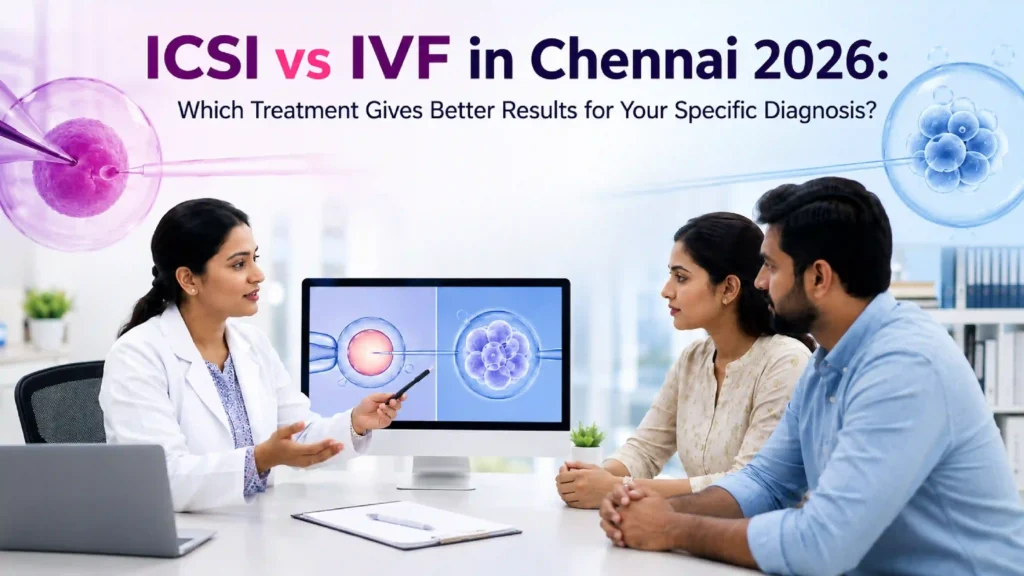
ICSI vs IVF in Chennai 2026: Which Treatment Gives Better Results for Your Specific Diagnosis?
ICSI vs IVF in Chennai 2026: Which Treatment Gives Better Results for Your Specific Diagnosis? Home ICSI, IVF July 4, 2026 Introduction If you and your partner are exploring fertility treatment options, you have likely come across two terms again and again: IVF and ICSI. Understanding ICSI vs IVF in Chennai can feel overwhelming, especially when you’re already navigating the emotional weight of an infertility diagnosis. You are not alone in this — many couples in Tambaram, Chennai, and across South Chennai are asking the same question: which treatment is right for us? This article breaks down the difference between IVF and ICSI in clear, accessible language, explains when each approach may be recommended, and outlines how a personalized diagnosis shapes the right path forward. At Promise Fertility Center, we believe informed patients make more confident decisions, and every fertility journey deserves clarity, compassion, and realistic expectations rather than one-size-fits-all promises. Understanding IVF: The Foundation of Assisted Reproduction In Vitro Fertilization, or IVF, is one of the most established forms of assisted reproductive technology. During IVF, eggs are retrieved from the ovaries and combined with sperm in a laboratory dish, allowing fertilization to occur naturally outside the body. The resulting embryo (or embryos) is then monitored before being transferred into the uterus. IVF is often recommended for couples dealing with: – Blocked or damaged fallopian tubes – Ovulation disorders – Endometriosis – Unexplained infertility – Diminished ovarian reserve – Situations where other treatments, such as IUI, have not led to pregnancy In traditional IVF, sperm and eggs are placed together, and fertilization happens on its own among a large number of healthy, motile sperm. Understanding ICSI: A Precision-Based Approach Intracytoplasmic Sperm Injection, or ICSI, is a specialized technique that is typically used alongside IVF rather than as a completely separate treatment. Instead of allowing fertilization to happen naturally in the dish, an embryologist selects a single, healthy sperm and injects it directly into the center of a mature egg using a fine glass needle under high magnification. This precision-based approach is especially valuable when natural fertilization is unlikely to succeed on its own. ICSI is commonly recommended for: – Male factor infertility, including low sperm count, poor motility, or abnormal sperm shape – Sperm retrieved surgically (in cases of blockage or absence of sperm in the ejaculate) – Previous IVF cycles where fertilization did not occur or was poor – Use of frozen sperm with limited quantity or quality – Certain cases involving frozen (vitrified) eggs ICSI vs IVF: What Is the Real Difference? The core difference between IVF and ICSI lies in how fertilization happens, not in the earlier steps of the process. Both treatments begin similarly: with ovarian stimulation, monitoring, and egg retrieval. The distinction appears at the fertilization stage. IVF relies on natural fertilization, where sperm fertilizes the egg on its own in a laboratory dish. ICSI involves directly injecting a single sperm into the egg to assist fertilization when natural fertilization may be difficult. Because of this, ICSI is frequently used as an added step within an IVF cycle, particularly when male infertility factors are present. Many patients in Tambaram and surrounding areas often ask, “Is ICSI better than IVF?” — but this is not quite the right question. ICSI is not a replacement for IVF; it is a tool used within IVF to improve the chances of fertilization when specific challenges exist. When Is ICSI Recommended Over Conventional IVF? Choosing between conventional IVF and IVF with ICSI depends entirely on the underlying cause of infertility, which is why a thorough diagnostic workup is essential before treatment begins. ICSI tends to be recommended when: – Semen analysis reveals significant male factor infertility – Sperm needs to be surgically retrieved – A previous IVF cycle resulted in failed or unexpectedly low fertilization – Genetic testing of embryos is planned, requiring precise fertilization control – Frozen eggs are being used, as their outer layer can sometimes make natural fertilization more difficult For couples without male factor infertility, conventional IVF may be equally effective, and ICSI may not offer any meaningful advantage. This is an important point: more advanced technology does not automatically mean better outcomes for every patient. The right treatment is the one matched to your specific diagnosis. Does ICSI Have a Higher Success Rate Than IVF? This is one of the most common questions couples in Tamil Nadu ask, and it deserves an honest, nuanced answer. ICSI was developed specifically to improve fertilization rates in cases of male infertility — and in those specific cases, it can meaningfully improve the chances that fertilization occurs. However, achieving fertilization is only one step in a much longer journey that includes embryo development, implantation, and a healthy pregnancy. For couples without male infertility factors, research does not consistently show that ICSI improves overall pregnancy or live birth outcomes compared to conventional IVF. Outcomes depend on a combination of factors, including age, egg and sperm quality, uterine health, and the underlying cause of infertility. Any fertility specialist who provides an honest assessment will emphasize that success is diagnosis-specific, not treatment-specific — which is exactly why an individualized evaluation matters more than following a general trend. The Treatment Journey: What to Expect While every patient’s path looks a little different, both IVF and IVF-with-ICSI generally follow a similar overall structure: Initial consultation and diagnostic testing — including hormone evaluation, ultrasound assessment, and semen analysis for the male partner Ovarian stimulation — using medication to encourage the ovaries to produce multiple mature eggs, with close monitoring throughout Egg retrieval — a minor procedure performed under sedation Fertilization — either conventional IVF or ICSI, depending on the diagnosis Embryo culture and monitoring — allowing embryologists to assess development Embryo transfer — placing a selected embryo into the uterus Pregnancy testing and follow-up care Throughout this journey, monitoring appointments, emotional check-ins, and open communication with your care team are