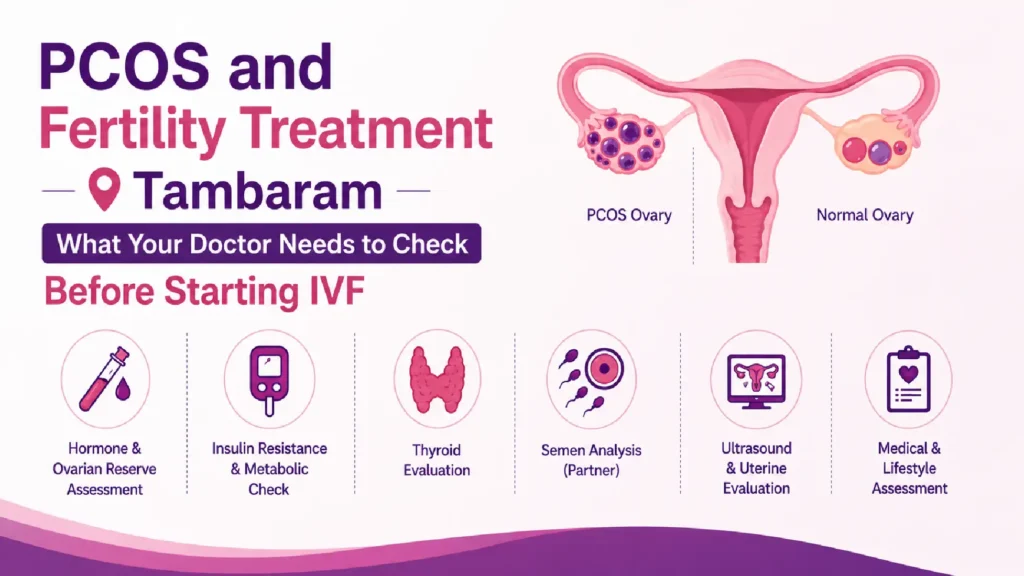
PCOS and Fertility Treatment in Tambaram: What Your Doctor Needs to Check Before Starting IVF
PCOS and Fertility Treatment in Tambaram: What Your Doctor Needs to Check Before Starting IVF Home IVF May 23, 2026 Introduction If you have been living with Polycystic Ovary Syndrome (PCOS) and are now exploring fertility treatment, you are not alone. PCOS is one of the most common hormonal conditions affecting women of reproductive age in India, and it is also one of the leading causes of irregular ovulation and difficulty conceiving. For many women in Tambaram and across South Chennai, accessing the right PCOS fertility treatment Tambaram has become an important and hopeful first step toward building a family. The good news is that PCOS does not mean you cannot become a mother. With the right medical evaluation, a carefully designed protocol, and a compassionate care team beside you, many women with PCOS go on to have successful pregnancies. However, the path to IVF with PCOS requires more preparation than a standard fertility treatment cycle. Certain hormonal imbalances and metabolic factors unique to PCOS must be assessed and thoughtfully addressed before treatment begins. This article walks you through the essential tests and evaluations your doctor should conduct before starting IVF — and explains clearly why each one matters for your safety, your health, and your chances of a positive outcome. Understanding PCOS and Its Impact on Fertility PCOS is a hormonal disorder in which the ovaries produce an excess of androgens (male hormones), often leading to irregular or absent menstrual cycles, multiple small follicles in the ovaries, and difficulty with natural ovulation. While every woman’s experience with PCOS is different, the condition can significantly affect fertility by disrupting the timing and quality of egg release. When considering IVF, PCOS presents a unique set of clinical challenges. Women with PCOS tend to have a higher number of antral follicles, which means they may respond more strongly to fertility medications than other patients. This increases the risk of a condition called Ovarian Hyperstimulation Syndrome (OHSS) — a serious but largely preventable complication when properly monitored and managed. This is why pre-treatment evaluation is not just a formality. It is a clinical necessity that forms the foundation of safe and effective IVF care. Essential Tests Your Doctor Must Perform Before IVF for PCOS A thorough pre-IVF evaluation for women with PCOS should cover hormonal, metabolic, and structural assessments. Here is what your fertility specialist should review before designing your treatment protocol. 1. Comprehensive Hormonal Panel Your doctor should measure a range of hormones to understand your baseline and guide medication dosing safely: FSH and LH (Follicle Stimulating Hormone and Luteinizing Hormone): An elevated LH-to-FSH ratio is a classic marker of PCOS and helps guide stimulation planning. AMH (Anti-Müllerian Hormone): A high AMH level, common in PCOS, indicates a large follicle pool and helps predict the risk of OHSS. Prolactin: Elevated prolactin can suppress ovulation and must be treated before IVF begins. Thyroid Function (TSH, T3, T4): Thyroid imbalances are frequently seen alongside PCOS and can affect implantation and early pregnancy health. Androgens (Testosterone, DHEAS): Elevated androgen levels can impact egg quality and may require management before stimulation. 2. Blood Sugar and Insulin Resistance Assessment Insulin resistance affects a significant proportion of women with PCOS, including those who are not overweight. Your doctor should check fasting blood glucose and insulin levels, and may recommend an oral glucose tolerance test (OGTT). If insulin resistance is detected, medications such as Metformin are often prescribed in the weeks before IVF to improve ovarian response and meaningfully reduce OHSS risk. 3. Antral Follicle Count (AFC) via Transvaginal Ultrasound A transvaginal ultrasound is essential to count the number of resting follicles in each ovary. In women with PCOS, the AFC is often high — typically more than 12 follicles per ovary — which directly influences the type and dosage of stimulation medications used. This scan also helps identify any ovarian cysts or uterine abnormalities that should be addressed before treatment begins. 4. Uterine Assessment and Endometrial Evaluation A healthy uterine lining is critical for successful embryo implantation. Your doctor should evaluate the shape and structure of your uterus using ultrasound, and in some cases, a saline infusion sonography (SIS) or hysteroscopy may be recommended to rule out polyps, fibroids, or scar tissue. Women with PCOS may also experience endometrial thickening due to hormonal imbalances, which needs careful assessment before proceeding. 5. Male Partner Semen Analysis Fertility treatment is a shared journey. A complete semen analysis — assessing sperm count, motility, morphology, and DNA fragmentation — is a standard and essential part of the pre-IVF workup for every couple. Identifying any male factor concerns early allows the team to plan the most appropriate fertilization technique, such as ICSI alongside IVF, from the very beginning. 6. General Health and Pre-Treatment Blood Work Standard pre-treatment investigations typically include: Complete blood count (CBC) and blood grouping Infectious disease screening (Hepatitis B, Hepatitis C, HIV, VDRL) Rubella immunity status Coagulation profile — particularly relevant when OHSS risk is elevated BMI assessment and blood pressure measurement These tests ensure that you are in the best possible health before beginning the physical and emotional demands of an IVF cycle. Why OHSS Prevention Is a Priority for PCOS Patients Ovarian Hyperstimulation Syndrome is the most important risk to manage in PCOS patients undergoing IVF. Because of the high follicle count associated with PCOS, the ovaries can over-respond to stimulation medications, leading to swelling, fluid accumulation, and in severe cases, serious health complications. An experienced fertility specialist will use the results of your AMH level, antral follicle count, and hormonal panel to design a low-dose, carefully tailored stimulation protocol. A GnRH antagonist protocol is frequently preferred for PCOS patients. In many cases, a freeze-all strategy is also recommended — where all embryos are frozen after retrieval and transferred in a later, hormonally calmer cycle. This approach significantly reduces OHSS risk while fully preserving your chance of a successful pregnancy. The Promise Fertility Centre Approach to PCOS and IVF in Tambaram At Promise Fertility Centre, we understand