
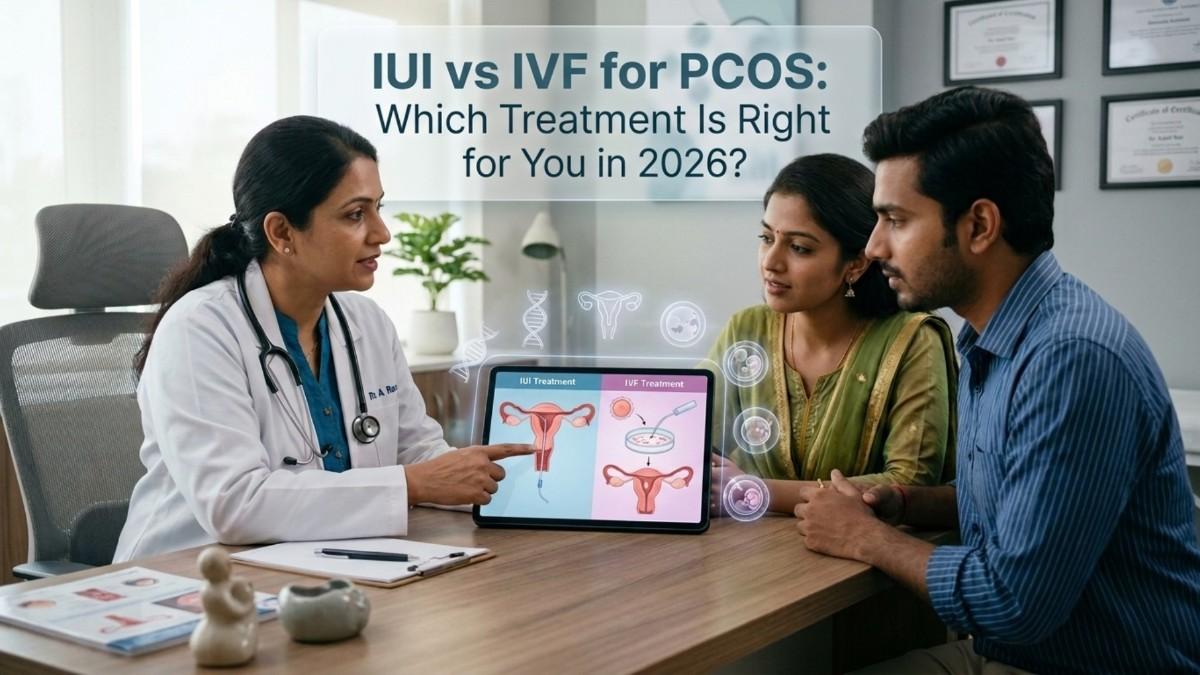
IUI vs IVF for PCOS: Which Treatment Is Right for You in 2026?
- IUI, IVF
- May 11, 2026
Introduction
If you have been diagnosed with PCOS (Polycystic Ovarian Syndrome) and are trying to conceive, you have likely come across two treatment options that keep appearing in your research — IUI and IVF. The question of IUI vs IVF for PCOS is one of the most common and important decisions that women with this condition face on their fertility journey.
PCOS is one of the leading causes of ovulation-related infertility, affecting a significant number of women across India, including many couples seeking fertility care in Tambaram and South Chennai. The good news is that PCOS is also one of the most treatable causes of infertility — and with the right specialist and the right treatment plan, pregnancy is an achievable goal for many women.
This article breaks down both IUI and IVF clearly and compassionately, explains how PCOS affects each treatment’s suitability, and helps you understand which path may be right for your unique situation.
You are not alone in this journey — and clarity is the first step forward.
PCOS is a hormonal condition in which the ovaries produce an excess of androgens (male hormones), leading to irregular or absent ovulation, multiple small follicles on the ovaries, and hormonal imbalances.
For fertility, the primary challenge PCOS presents is irregular or unpredictable ovulation — meaning eggs may not be released consistently, making natural conception difficult.
Common fertility-related symptoms of PCOS include:
- Irregular or missed menstrual cycles
- Absent ovulation (anovulation)
- Elevated LH and testosterone levels
- Insulin resistance
- Multiple small follicles visible on ultrasound
The specific impact of PCOS on your fertility will depend on the severity of your condition, your age, your partner’s sperm health, and whether other fertility factors are present.
What Is IUI? A Simple Overview
IUI (Intrauterine Insemination) is a relatively simple, minimally invasive fertility procedure. It involves placing washed and concentrated sperm directly into the uterus around the time of ovulation — increasing the chances of sperm reaching and fertilizing an egg.
For women with PCOS, IUI is typically combined with:
- Ovulation induction medications (such as Clomiphene or Letrozole) to stimulate the ovaries to release an egg
- Trigger injections to time ovulation precisely
- Careful monitoring via ultrasound to track follicle development
What to Expect During IUI
- The process is typically completed within one menstrual cycle
- It is an outpatient procedure with no anesthesia required
- Mild cramping may occur but most women resume normal activity the same day
- A pregnancy test is conducted approximately two weeks after the procedure
IUI Success Rates for PCOS
IUI success rates for PCOS patients vary based on age, ovarian response, and sperm quality. Per cycle success rates generally range between 10% and 20%, though cumulative success after multiple cycles can be higher. These figures vary significantly based on individual factors and should be discussed with your specialist.
What Is IVF? A Clear Explanation
IVF (In Vitro Fertilization) is a more advanced assisted reproductive technology. It involves stimulating the ovaries to produce multiple eggs, retrieving those eggs, fertilizing them with sperm in a specialized laboratory, and transferring the resulting embryo into the uterus.
For women with PCOS, IVF offers greater control over the entire fertilization process and is particularly beneficial when:
- IUI has not been successful after multiple attempts
- There are additional fertility factors (such as tubal issues or male factor infertility)
- The woman is older and time is a consideration
- A more targeted, higher-success approach is medically indicated
What to Expect During IVF
- Ovarian stimulation with injectable medications over 8–12 days
- Regular ultrasound and blood test monitoring
- Egg retrieval under light sedation
- Embryo development in the laboratory over 3–5 days
- Embryo transfer (fresh or frozen cycle)
- Pregnancy test approximately 10–14 days after transfer
Special Consideration for PCOS: OHSS Risk
Women with PCOS have a higher risk of Ovarian Hyperstimulation Syndrome (OHSS) during IVF — a condition where the ovaries over-respond to stimulation medications. Experienced fertility specialists manage this risk through:
- Careful medication dosing and monitoring
- Use of antagonist protocols designed to minimize OHSS
- Freeze-all strategies where all embryos are frozen and transferred in a later, safer cycle
At a well-equipped clinic, OHSS risk can be significantly reduced with proper monitoring and individualized protocols.
IUI vs IVF for PCOS: A Side-by-Side Comparison
Factor | IUI | IVF |
Invasiveness | Minimal | Moderate |
Medication Intensity | Low to moderate | Higher |
Monitoring Required | Less frequent | Frequent |
Success Rate Per Cycle | 10–20% | 40–60%* |
Cost Per Cycle | Lower | Higher |
Best For | Mild PCOS, good sperm health | Complex cases, failed IUI |
OHSS Risk | Low | Higher (manageable) |
Time Commitment | Shorter | Longer |
*IVF success rates vary significantly based on age, diagnosis, embryo quality, and clinic protocols. These figures are general estimates and not guarantees.
Which Treatment Is Right for You?
This is the question every couple with PCOS wants answered — and the honest answer is: it depends on your individual medical profile.
IUI May Be Recommended First If:
- You are under 35 with a good ovarian reserve
- Your fallopian tubes are open and healthy
- Your partner’s sperm parameters are within normal range
- Your PCOS is mild to moderate with good response to ovulation induction
- You are in the early stages of fertility treatment
IVF May Be Recommended If:
- You have not conceived after 3–4 IUI cycles
- Your partner has significant sperm issues requiring ICSI
- You have blocked or damaged fallopian tubes
- You are over 35 and time is an important factor
- Your PCOS is severe or your ovarian response to IUI medications is unpredictable
- Genetic testing of embryos is recommended for your situation
It is important to remember that starting with IUI does not mean IVF is a failure — it is simply a stepped approach that many fertility specialists recommend for appropriate candidates. The right treatment is the one that matches your body, your diagnosis, and your personal circumstances.
Promise Fertility Center: Expert PCOS Fertility Care in Tambaram
At Promise Fertility Center in Tambaram, Chennai, we have deep experience in managing fertility for women with PCOS. We understand that PCOS presents differently in every woman — which is why we never apply a generic treatment plan.
Our PCOS Fertility Approach
Every patient undergoes a thorough evaluation including:
- Hormonal blood panels and AMH testing
- Detailed ultrasound assessment of ovarian follicles
- Insulin resistance screening
- Complete semen analysis for the partner
Based on this evaluation, our fertility specialists develop a personalized treatment pathway — recommending IUI, IVF, or a stepped approach based on what is most medically appropriate for you, not what is most convenient or cost-driven.
Services We Offer for PCOS Patients
- Ovulation induction and cycle monitoring
- IUI with careful ovarian stimulation
- IVF and ICSI with PCOS-specific protocols
- Freeze-all embryo strategies to minimize OHSS risk
- Endocrine and hormonal management alongside fertility treatment
- Nutritional and lifestyle counseling to support PCOS management
- Emotional support and counseling throughout treatment
Accessible from South Chennai
Our center is conveniently located in Tambaram, making it easily accessible for patients from Chromepet, Pallavaram, GST Road, Guduvanchery, Vandalur, and surrounding areas. Frequent monitoring appointments during IVF are far less stressful when your clinic is close to home.
Practical Information for Your First Consultation
When to seek a fertility consultation for PCOS:
- You have been trying to conceive for 6–12 months with known PCOS
- Your periods are very irregular or absent
- You have previously been told ovulation is not occurring regularly
- You want to understand your fertility options before starting to try
What to bring:
- Previous PCOS diagnosis reports and hormone test results
- Recent ultrasound reports if available
- Partner’s semen analysis (if done)
- List of current medications including any for PCOS management
On costs: IUI is considerably more affordable than IVF per cycle. Our team will provide a clear, itemized cost estimate and discuss the most appropriate and cost-effective treatment path for your specific situation.
Conclusion: The Right Choice Starts with the Right Conversation
The debate of IUI vs IVF for PCOS does not have a single universal answer — but it does have a right answer for you, based on your age, diagnosis, medical history, and personal circumstances.
What matters most is that you receive an honest, personalized assessment from a fertility specialist who truly understands PCOS — and who will guide you with both clinical expertise and genuine compassion.
At Promise Fertility Center in Tambaram, we are here to help you make that decision with clarity, confidence, and care.
Take your next step today: Schedule a confidential PCOS fertility consultation. Our team will evaluate your complete picture and help you choose the treatment path that gives you the best chance of achieving your dream of parenthood.
📞 Contact Promise Fertility Center, Tambaram, Chennai — compassionate PCOS fertility care, right in your neighbourhood.
Q: What is the difference between IVF and ICSI?
In standard IVF, eggs and sperm are placed together in a laboratory dish and fertilisation occurs naturally. In ICSI, a single sperm is injected directly into each egg. ICSI is recommended when there is a male factor concern, such as low sperm count or poor motility, or when previous IVF cycles have had poor fertilisation results.
Q: Is preimplantation genetic testing recommended for everyone?
No. PGT is most beneficial for specific patient groups — women over 35, couples with a history of recurrent miscarriage or implantation failure, and those who carry a known genetic condition. Your fertility specialist will advise whether PGT is clinically appropriate for your situation.
Q: Is egg freezing effective? How long can eggs be stored?
With modern vitrification techniques, egg survival rates after thawing are consistently high. Eggs can be stored for extended periods — in India, ICMR guidelines currently allow storage for up to five years, with the possibility of extension under specific circumstances. The effectiveness of egg freezing is influenced by the woman’s age at the time of freezing; younger women generally achieve better outcomes.
Q: How many IVF cycles might I need?
This varies significantly based on age, diagnosis, embryo quality, and individual response to treatment. Some couples conceive in their first cycle; others require multiple attempts. Your fertility specialist will give you a realistic assessment based on your specific clinical profile — no ethical clinic can guarantee a pregnancy outcome.
Q: Does advanced technology guarantee IVF success?
No. Advanced reproductive technology significantly improves the precision, safety, and potential outcomes of fertility treatment — but it does not guarantee pregnancy. Success depends on a combination of factors including age, egg and sperm quality, embryo development, and uterine receptivity. Promise Fertility Center is committed to presenting realistic expectations at every stage.
Q: Are advanced fertility treatments affordable in Chennai?
The cost of ART procedures varies depending on the specific treatment required, the number of cycles undertaken, and whether additional tests or techniques such as PGT or time-lapse monitoring are used. At Promise Fertility Center, we provide transparent pricing and discuss all cost considerations openly before treatment begins, so there are no unexpected surprises.
Q: What should I do if I have failed IVF cycles elsewhere?
A failed IVF cycle is a significant and difficult experience. It does not mean that future success is impossible — it means that a thorough review of all previous treatment details is needed to identify what adjustments may improve outcomes. Our team welcomes couples who have had previous unsuccessful cycles and will conduct a comprehensive assessment before recommending next steps.
Medical Disclaimer: This article is for informational purposes only and does not constitute medical advice. Success rates mentioned are general estimates and vary based on individual medical factors including age, diagnosis, and treatment response. Never make fertility treatment decisions based on online content alone. Please consult a qualified fertility specialist for a personalized evaluation and treatment recommendation.