
Fertility Testing in Chennai: Complete Diagnosis & What Tests You Need
Introduction
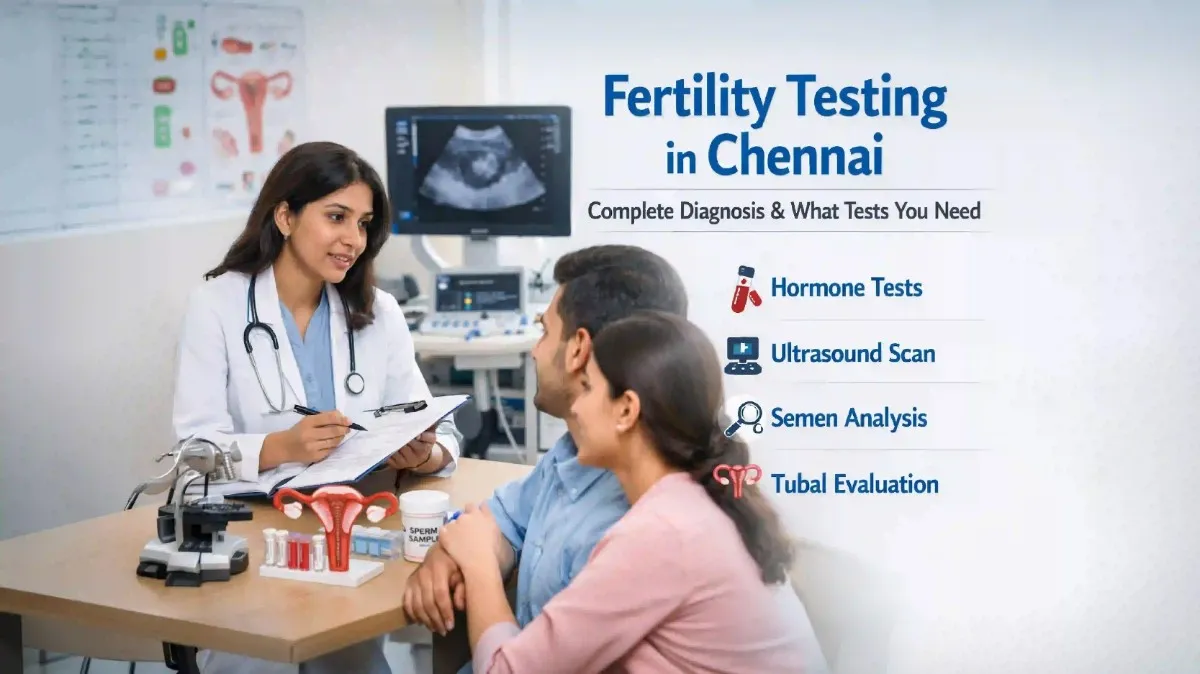
When months of trying to conceive pass without success, the uncertainty can be deeply unsettling. Many couples find themselves asking whether something is wrong, and if so, what exactly it might be. The honest answer is that fertility challenges can stem from many different causes, and the only way to know for certain is through proper medical evaluation. Fertility testing in Chennai has become increasingly accessible, and getting tested is not a sign of failure. It is a sign of taking informed, proactive action. At Promise Fertility Center in Tambaram, Chennai, we believe that accurate diagnosis is the foundation of every successful fertility journey. Knowing what tests are needed, what they measure, and what the results mean can help couples move forward with clarity rather than confusion. This article walks you through the complete fertility testing process for both women and men, explaining each assessment in plain language so that you feel informed and prepared before you even walk through the door.
Infertility is defined medically as the inability to conceive after twelve months of regular, unprotected intercourse for couples where the woman is under 35, or after six months when the woman is 35 or older. However, testing does not have to wait until these timeframes have passed. Couples with known risk factors such as irregular periods, previous pelvic infections, hormonal disorders, or a history of testicular issues may benefit from earlier evaluation.
The purpose of fertility testing is not to label a couple as infertile. It is to identify any specific factors that may be reducing the chance of natural conception and to guide the most appropriate treatment path. In many cases, investigations reveal manageable or treatable conditions. In some cases, results come back normal, which while initially puzzling, still provides useful information and narrows down the diagnostic possibilities.
Fertility Testing for Women: What to Expect
A thorough female fertility assessment covers several key areas including hormonal health, ovarian reserve, reproductive anatomy, and ovulation function.
The first and most important hormonal test for women is the Anti-Mullerian Hormone test, commonly known as the AMH test. AMH is produced by small follicles in the ovaries and provides a reliable indicator of ovarian reserve, meaning the number of eggs remaining. A low AMH level suggests reduced ovarian reserve, which can affect both natural conception and response to fertility treatment. Importantly, the AMH test in Chennai can be done at any point in the menstrual cycle, making it a convenient and widely used starting point.
Alongside AMH, a Day 2 or Day 3 hormonal blood panel is typically recommended. This measures Follicle Stimulating Hormone, known as FSH, Luteinizing Hormone, known as LH, and Estradiol. These hormones regulate the menstrual cycle and egg development. Elevated FSH levels can indicate that the ovaries are working harder than normal to stimulate egg production, which may point to reduced ovarian reserve. Thyroid function tests and prolactin levels are also commonly included, as both thyroid disorders and elevated prolactin can disrupt ovulation and menstrual regularity.
An antral follicle count, performed via transvaginal ultrasound, complements the AMH result by allowing the doctor to visually count the small resting follicles in each ovary. This scan also evaluates the uterus for structural abnormalities such as fibroids, polyps, or signs of adenomyosis that could affect implantation.
Ovulation tracking is another important component of female fertility assessment. This can be done through blood tests measuring progesterone levels in the second half of the cycle, or through serial ultrasound monitoring that tracks follicle growth and confirms that ovulation has occurred. Women with irregular cycles or suspected polycystic ovary syndrome, known as PCOS, particularly benefit from this type of monitoring.
A fallopian tube evaluation may also be recommended. The most common method is a Hysterosalpingography, or HSG, which is an X-ray procedure that uses a contrast dye to assess whether the fallopian tubes are open and the uterine cavity is normal. Blocked tubes prevent sperm from reaching the egg and are a significant cause of infertility that requires medical intervention.
In some cases, a hysteroscopy or laparoscopy may be advised if the initial investigations suggest uterine or pelvic abnormalities that need direct visualization and possible treatment.
Fertility Testing for Men: What to Expect
Male factor infertility contributes to approximately half of all infertility cases, yet male testing is sometimes overlooked or delayed. At Promise Fertility Center, we emphasize that male evaluation should happen simultaneously with female testing, not as an afterthought.
The cornerstone of male fertility assessment is the semen analysis. This test evaluates sperm concentration, total count, motility which refers to the percentage of sperm moving and the quality of that movement, morphology which refers to the shape and structure of sperm, and semen volume. Results are assessed against World Health Organization reference ranges to determine whether parameters fall within normal limits.
If the initial semen analysis shows abnormalities, a repeat test is usually recommended after two to three weeks, since sperm quality can fluctuate. If abnormalities are confirmed, further investigations may include hormonal blood tests measuring FSH, LH, testosterone, and prolactin to assess the hormonal drivers of sperm production. A scrotal ultrasound may be recommended to detect varicocele or structural concerns in the testis or epididymis.
In cases where no sperm are found in the ejaculate, a condition called azoospermia, a testicular biopsy may be discussed to determine whether sperm are being produced within the testis but blocked from release, or whether production itself is absent. Genetic testing, including karyotype analysis and Y chromosome microdeletion testing, may also be advised in selected cases to understand underlying causes.
Sperm DNA fragmentation testing is an advanced assessment that measures the integrity of the genetic material within sperm. High levels of DNA fragmentation can affect fertilization and embryo development even when standard semen parameters appear acceptable, making this test particularly releva]nt for couples with unexplained infertility or repeated IVF failure.
Understanding Your Results
Receiving fertility test results can bring up a range of emotions. Normal results can be reassuring but also confusing when conception has still not occurred. Abnormal results, while difficult to process, often bring a sense of clarity and direction. Either way, test results should always be discussed in the context of a thorough consultation with an experienced fertility specialist who can interpret findings in relation to your complete history.
At Promise Fertility Center, no result is ever handed over without a detailed explanation. Our specialists take the time to ensure that couples understand what findings mean, what they do not mean, and what options are available based on the complete picture.
Promise Fertility Center's Approach to Fertility Assessment
At Promise Fertility Center in Tambaram, Chennai, our fertility assessment process is comprehensive, structured, and genuinely patient-centered. We evaluate both partners from the outset and do not treat fertility diagnosis as a checklist exercise. Every test we recommend has a clear clinical rationale, and we explain that rationale to you before proceeding.
Our in-house diagnostic capabilities include advanced hormonal testing, antral follicle count ultrasounds, semen analysis in our accredited andrology laboratory, hysteroscopy, and coordination of specialized genetic or immunological investigations where indicated. Our fertility specialists bring significant experience in interpreting complex diagnostic pictures and translating findings into actionable, individualized treatment plans.
We also recognize that undergoing fertility testing can be emotionally taxing. Our team offers counseling support throughout the diagnostic process so that couples feel held and informed rather than isolated with their concerns. Fertility assessment is not just a medical process. It is the beginning of a partnership between you and your care team, and we take that responsibility seriously.
Promise Fertility Center is conveniently located in Tambaram and is easily accessible for patients from Chromepet, Pallavaram, Perungalathur, Guduvanchery, and across South Chennai via the GST Road corridor.
Practical Information for Getting Started
If you have been trying to conceive for twelve months without success, or six months if you are over 35, it is time to schedule a fertility assessment. Couples with known hormonal conditions, irregular cycles, prior reproductive surgery, or male factor concerns should seek evaluation sooner.
For your first appointment, bring any prior test results, scan reports, or medical records that may be relevant. Both partners attending together for the initial consultation is encouraged wherever possible. Our team will discuss costs transparently and can advise on which tests are most clinically appropriate for your specific situation, helping you avoid unnecessary expenses.
Knowledge Is the First Step Forward
Fertility testing is not about confirming fear. It is about gaining the knowledge you need to move forward with purpose and clarity. Whatever your results show, there is almost always a path forward, and understanding your situation clearly is what makes that path navigable.
At Promise Fertility Center in Tambaram, Chennai, we are committed to providing thorough, honest, and compassionate fertility assessments for every couple who walks through our doors. Contact us today to schedule your complete fertility evaluation and take the first meaningful step toward your family-building goals.
Disclaimer: This article is for general informational purposes only and does not constitute medical advice. The tests recommended for any individual or couple will vary based on clinical history and specialist assessment. Please consult a qualified fertility specialist for personalized diagnostic guidance.