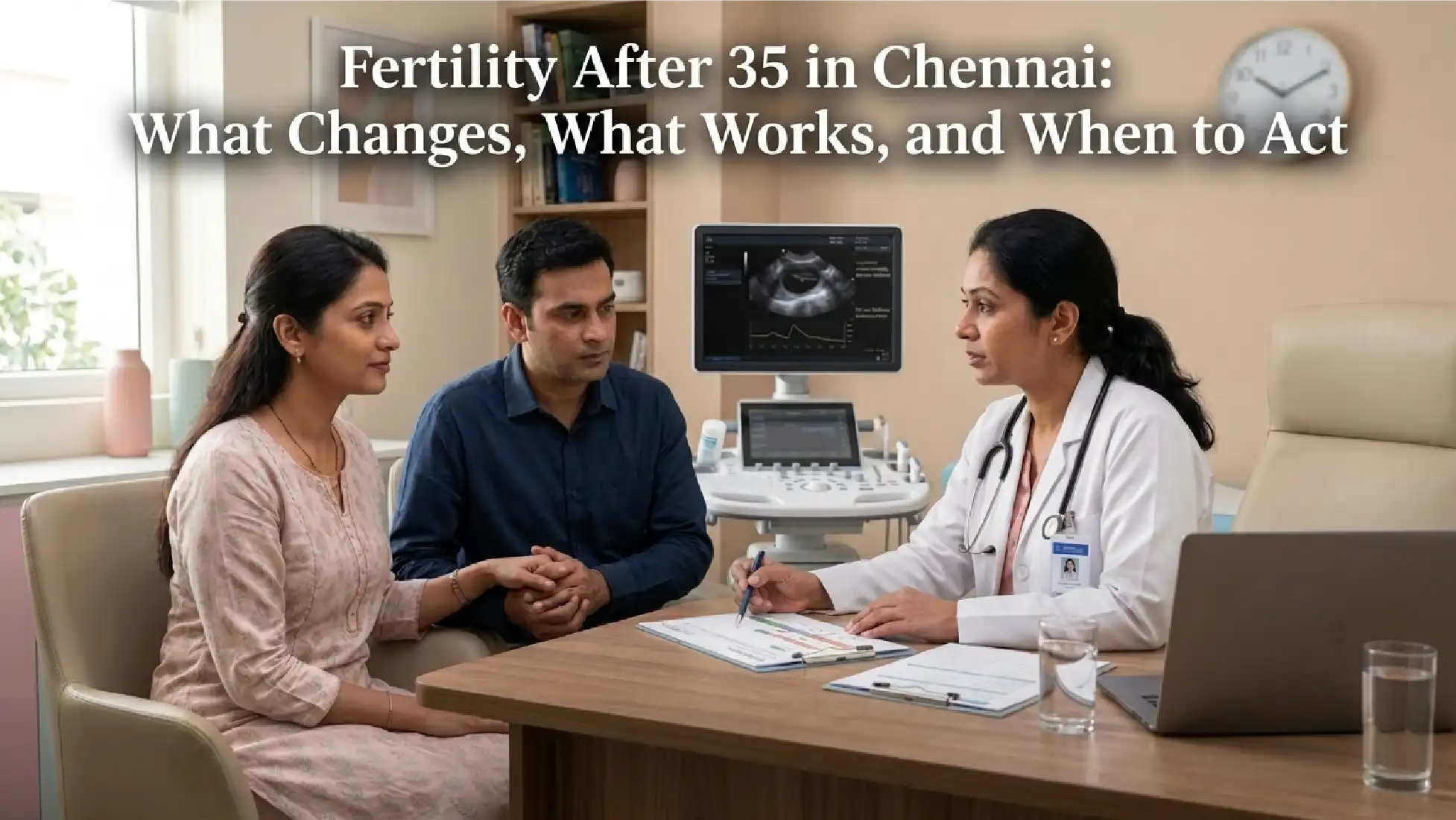
Fertility After 35 in Chennai: What Changes, What Works, and When to Act
- Embryology
- June 1, 2026
Introduction
More women in Chennai and across Tamil Nadu are choosing to start or grow their families after the age of 35 — and for many deeply personal and practical reasons. Career milestones, finding the right partner, financial stability, or simply being ready — these are all valid and understandable parts of life’s timeline. Yet when it comes to fertility after 35 Chennai, it is important to have clear, honest information about what biological changes are occurring and what options are genuinely available to you.
The good news is that being over 35 does not mean parenthood is out of reach. Many women in this age group conceive naturally or with the support of fertility treatments and go on to have healthy pregnancies. What it does mean is that time becomes a more significant factor, and seeking specialist guidance sooner rather than later can make a meaningful difference to your options and outcomes.
This article explains what actually changes in fertility after 35, which treatments are most effective for women in this age group, and when the right time is to consult a fertility specialist in Tambaram or South Chennai.
Understanding the biology behind age-related fertility decline helps to remove fear and replace it with informed action. Here is what is happening, explained clearly.
Ovarian Reserve Declines With Age
A woman is born with all the eggs she will ever have. From birth onward, that number gradually decreases. By the mid-thirties, the rate of decline accelerates, meaning both the quantity and quality of remaining eggs reduce more noticeably with each passing year.
This is measured clinically through ovarian reserve testing — specifically AMH (Anti-Müllerian Hormone) levels and an antral follicle count (AFC) via ultrasound. These tests give your fertility specialist a picture of how many eggs your ovaries currently contain and how they are likely to respond to stimulation.
Egg Quality and Chromosomal Health
As eggs age, they become more susceptible to chromosomal abnormalities — errors in the genetic material that can prevent fertilization, lead to failed implantation, or result in early miscarriage. This is one of the primary reasons why natural conception rates decline and miscarriage rates increase after the age of 35.
It is important to note that this is a gradual process, not a sudden cliff. Many women over 35 produce chromosomally normal eggs and achieve successful pregnancies — but the proportion of eggs with chromosomal issues does increase with age.
The Menstrual Cycle and Ovulation
For many women, menstrual cycles remain regular well into the late thirties and beyond. However, the luteal phase — the period between ovulation and menstruation — may shorten slightly with age, and ovulation itself can become less predictable. These subtle changes can reduce the natural conception window each month.
Male Fertility and Age
It is worth noting that male fertility also changes with age, though the decline is more gradual. Sperm DNA fragmentation rates tend to increase as men get older, and this can affect embryo quality and pregnancy outcomes. For couples over 35, evaluating both partners thoroughly is always important.
Can I Get Pregnant Naturally After 35 in Chennai?
Yes — many women over 35 conceive naturally without any medical assistance. Age is one factor in fertility, but it is not the only one. Women with good ovarian reserve, regular ovulation, open fallopian tubes, and a partner with healthy sperm parameters have a reasonable chance of natural conception even after 35.
However, the timeframe for trying naturally before seeking specialist advice is shorter than for younger women. While couples under 35 are generally advised to try for 12 months before consulting a fertility specialist, the recommendation for women over 35 is to seek an evaluation after just six months of trying without success.
For women over 40, many specialists recommend a fertility consultation before actively trying to conceive — or very soon after beginning — simply because time is the most important variable at this stage.
What Fertility Treatments Work Best After 35?
The most appropriate treatment depends entirely on your individual diagnosis, ovarian reserve, and the findings of a thorough fertility evaluation. Here is an honest overview of the options most commonly relevant to women in this age group.
Ovulation Induction and Timed Intercourse
For women with good ovarian reserve who are ovulating irregularly, medications to stimulate or regulate ovulation — combined with carefully timed intercourse — may be the simplest and most appropriate starting point.
IUI (Intrauterine Insemination)
IUI may be appropriate for women over 35 when sperm parameters are the primary concern and the fallopian tubes are confirmed to be open. However, given the time sensitivity of fertility after 35, many specialists recommend a limited trial of IUI — typically two to three cycles — before considering IVF if conception has not occurred.
IVF is frequently the most effective treatment option for women over 35, particularly when ovarian reserve is reduced, previous treatments have not succeeded, or when time is a significant factor. IVF allows for the retrieval and fertilization of multiple eggs in a single cycle, the selection of the best-quality embryos for transfer, and the option to freeze additional embryos for future attempts.
For women over 35, IVF also opens the door to Preimplantation Genetic Testing (PGT-A) — chromosomal screening of embryos before transfer — which can improve implantation rates and reduce the risk of miscarriage by identifying chromosomally normal embryos for transfer.
ICSI (Intracytoplasmic Sperm Injection)
When male factor infertility is also present, ICSI — in which a single sperm is injected directly into each egg — is used alongside IVF to maximize fertilization rates. This is particularly relevant for couples over 35 where both partners may be experiencing age-related changes in fertility.
Fertility Preservation — If You Are Not Ready Yet
For women over 35 who are not yet ready to conceive but are concerned about their future fertility, egg freezing (oocyte cryopreservation) offers a meaningful option. Freezing eggs now preserves them at their current quality for use in future IVF treatment. The earlier this is done, the better the quality of eggs that can be preserved.
Lifestyle Factors That Support Fertility After 35
While medical treatment addresses clinical factors, certain lifestyle adjustments can support overall reproductive health and improve treatment outcomes:
- Maintaining a healthy body weight: Both underweight and overweight conditions can affect hormonal balance and ovulation
- Reducing alcohol consumption and quitting smoking: Both have measurable negative effects on egg quality and IVF outcomes
- Managing stress: Chronic stress can disrupt hormonal balance; evidence-based stress management — including counseling — is genuinely beneficial during fertility treatment
- Adequate folic acid and vitamin D: Nutritional support is important before and during early pregnancy; your specialist will advise on appropriate supplementation
- Regular, moderate exercise: Supports hormonal health without placing excessive physical stress on the body
These steps will not reverse age-related changes in ovarian reserve, but they do support the best possible environment for conception and a healthy pregnancy.
The Promise Fertility Centre Approach to Fertility After 35 in Tambaram
At Promise Fertility Centre, we see many women and couples who come to us at 35, 37, 40, and beyond — each with a unique story, a different clinical picture, and their own deeply held hopes. Our approach is never to apply a standard protocol based on age alone. It is to understand your individual situation fully and to design a plan that reflects both medical best practice and genuine respect for your personal circumstances.
Our specialist team, including Dr. Annith Kumar (Infertility Specialist) and Dr. Umaiyal Murugesan (Obstetrician and Gynaecologist), brings over 35 years of combined experience in managing age-related fertility challenges. We conduct thorough ovarian reserve assessments, provide honest guidance on which treatments are most appropriate for your profile, and support you with advanced laboratory capabilities including IVF, ICSI, PGT-A where indicated, and fertility preservation services.
What you can expect at our clinic:
- A comprehensive fertility evaluation that goes beyond a basic blood test
- Personalized treatment recommendations based on your age, diagnosis, and ovarian reserve
- Transparent, compassionate guidance — including honest conversations about realistic expectations
- Emotional support and counseling throughout your treatment journey
- Accessible care from our West Tambaram clinic (open 24 hours), with additional locations in Rajakilpakkam and Guduvancheri
We serve women and couples from Chromepet, Pallavaram, GST Road, Vandalur, and across South Chennai, ensuring that specialist fertility care does not require long journeys at an already demanding time.
Practical Information: When to See a Fertility Specialist After 35
If you are over 35 and trying to conceive, seek a specialist consultation if:
- You have been trying for six months without success
- You have a known condition such as PCOS, endometriosis, or irregular cycles
- You have experienced one or more miscarriages
- You are considering egg freezing before beginning to try to conceive
- You simply want a baseline fertility assessment to understand where you stand
For your first appointment, bring any recent blood test results, previous ultrasound reports, and a record of your menstrual cycle history. If your partner has had a semen analysis, bring that report as well. Our team will guide you through every step of the evaluation clearly and without jargon.
Frequently Asked Questions
Can I get pregnant naturally after 35 in Chennai?
Yes, many women over 35 conceive naturally. However, fertility does decline with age, and the recommendation is to seek a specialist consultation after six months of trying without success — rather than the 12-month guideline for women under 35. Early evaluation ensures you have a full picture of your fertility and can make informed decisions about next steps.
What fertility treatments work best after 35 in Tamil Nadu?
The most effective treatment depends on your individual diagnosis and ovarian reserve. IVF is frequently the most appropriate option for women over 35, particularly when time is a factor or previous treatments have not succeeded. PGT-A chromosomal screening of embryos can also improve IVF outcomes in this age group. A thorough specialist consultation is the essential first step.
When should I see a fertility specialist if I am over 35 in Tambaram?
If you are over 35 and have been trying to conceive for six months without success, it is time to book a specialist consultation. Promise Fertility Centre in West Tambaram offers comprehensive fertility evaluations and is conveniently accessible from Pallavaram, Chromepet, and across the GST Road corridor.
Time Is a Factor — But It Is Not the Only One
Being over 35 does not close the door on parenthood. It does mean that the door is best approached sooner rather than later — with clear information, the right specialist by your side, and a plan that reflects your individual situation rather than a generic timeline.
At Promise Fertility Centre in Tambaram, Chennai, we are here to help you understand exactly where you stand, what your options are, and what your most realistic path forward looks like. We believe that informed hope is the most powerful kind — and we are committed to providing it with honesty, expertise, and genuine care.
Take the step that matters most. Book your consultation today.
📞 West Tambaram (24 Hours): +91 96006 90349 📞 Guduvancheri: +91 95000 18041 📧 promisefertilitycenter@gmail.com 🌐 www.promisefertilitycenter.com
Medical Disclaimer: This article is intended for informational purposes only and does not constitute medical advice. Fertility outcomes vary based on individual medical history, age, diagnosis, ovarian reserve, and other clinical factors. No treatment outcomes are guaranteed. Please consult a qualified fertility specialist for personalised medical guidance. Promise Fertility Centre is committed to transparent, ethical, and evidence-based reproductive care.