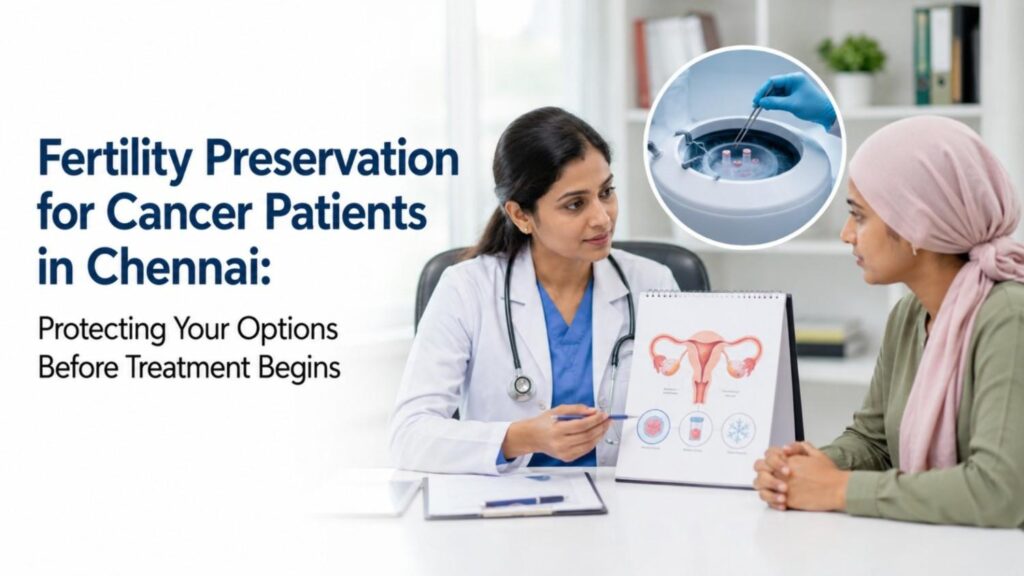
Fertility Preservation for Cancer Patients in Chennai: Protecting Your Options Before Treatment Begins
Fertility Preservation for Cancer Patients in Chennai: Protecting Your Options Before Treatment Begins Home Fertility Preservation June 28, 2026 Introduction A cancer diagnosis brings an overwhelming flood of emotions — fear, uncertainty, and questions about the future. For many patients, especially those of reproductive age, one of the most pressing concerns is: will I still be able to have children after treatment? If you are facing cancer treatment and are worried about your fertility, you are not alone — and there is hope. Fertility preservation for cancer patients in Chennai has made it possible for individuals to protect their reproductive options before chemotherapy, radiation, or surgery begins. Through a field called oncofertility, reproductive medicine and oncology work hand in hand to help patients safeguard their future family-building possibilities. This article is written for cancer patients, their partners, and caregivers in Chennai and South Tamil Nadu who want to understand what fertility preservation involves, which options are available, and how to act quickly — because timing is critical. At Promise Fertility Center in Tambaram, Chennai, a dedicated team is here to guide you through this process with compassion, clarity, and medical expertise. Why Cancer Treatment Affects Fertility Cancer treatments — while life-saving — can have a significant impact on reproductive health. Understanding how this happens helps patients make timely, informed decisions. Chemotherapy Many chemotherapy drugs, particularly alkylating agents, are toxic to reproductive cells. In women, they can damage the ovarian reserve — the pool of eggs available for future pregnancy. In men, chemotherapy can reduce sperm count, motility, and quality, sometimes temporarily and sometimes permanently. Radiation Therapy Radiation directed at or near the pelvis, abdomen, or reproductive organs can damage the ovaries, uterus, or testes. Even radiation targeting other parts of the body can affect fertility if scattered doses reach reproductive tissues. In some cases, the pituitary gland — which regulates reproductive hormones — may also be affected by radiation to the brain. Surgery Surgeries involving the reproductive organs, pelvis, or nearby structures can directly impact fertility depending on what needs to be removed or reconstructed. The degree of fertility impact depends on the type of cancer, the specific treatment protocol, the patient’s age, and their baseline reproductive health before treatment. This is why consulting an oncofertility specialist as early as possible — ideally before treatment begins — is so important. Fertility Preservation Options for Cancer Patients Modern reproductive medicine offers several fertility preservation methods. The right option depends on the patient’s sex, age, cancer type, urgency of treatment, and personal circumstances. For Women Egg Freezing (Oocyte Cryopreservation) Egg freezing before chemotherapy in Chennai involves stimulating the ovaries with hormonal injections over several days, retrieving mature eggs, and freezing them for future use. This is a well-established and widely recommended option for women who do not yet have a partner or prefer to preserve eggs independently. Embryo Freezing For women with a partner or who choose to use donor sperm, retrieved eggs can be fertilized to create embryos, which are then frozen. Embryo freezing has a longer track record in reproductive medicine and remains a standard oncofertility option. Ovarian Tissue Cryopreservation In cases where there is no time for ovarian stimulation — such as when cancer treatment must begin immediately — ovarian tissue can be surgically removed, frozen, and later reimplanted after treatment. This is a newer option, increasingly available at specialized fertility centers, and is particularly relevant for pre-pubertal girls or those who cannot delay treatment. Ovarian Transposition (Oophoropexy) If radiation is part of the treatment plan, ovarian transposition is a surgical procedure that moves the ovaries away from the radiation field, helping to protect them from damage. For Men Sperm Banking (Sperm Cryopreservation) Sperm banking is the most straightforward and time-efficient fertility preservation method for men. A semen sample is collected, analyzed, and frozen before cancer treatment begins. It is non-invasive and can be completed quickly, making it accessible even for patients with urgent treatment timelines. Testicular Sperm Extraction (TESE) For men who are unable to produce a sample through conventional means, sperm can be surgically retrieved directly from the testicular tissue and frozen for future use. Timing: Why Acting Quickly Matters One of the most important aspects of oncofertility is timing. Fertility preservation ideally takes place before cancer treatment begins, as chemotherapy and radiation can begin affecting reproductive cells quickly. For women undergoing egg or embryo freezing, the stimulation process typically takes several days, followed by the egg retrieval procedure. In many cases, this can be completed within a treatment window without significantly delaying cancer care — but coordination between the oncologist and fertility specialist is essential. For men, sperm banking can be completed in a single appointment, making it one of the fastest preservation options available. If you or a loved one has recently received a cancer diagnosis, reaching out to an oncofertility specialist at the same time as beginning oncology consultations is strongly advisable. Do not wait until after treatment to explore your options. Emotional Aspects of Fertility Preservation During Cancer Facing cancer is emotionally exhausting. Adding fertility decisions to that experience can feel like too much to process at once. It is completely normal to feel overwhelmed, uncertain, or even conflicted about whether to pursue preservation. What matters is that you have access to clear information and compassionate guidance — without pressure. Some patients feel a profound sense of hope knowing they are taking a proactive step to protect their future. Others need time to process before deciding. Both responses are valid. Counseling and emotional support are a meaningful part of oncofertility care. Having a dedicated team that understands both the medical and emotional dimensions of this journey makes a real difference. Promise Fertility Center’s Role in Oncofertility Care Promise Fertility Center in Tambaram, Chennai, offers specialized oncofertility consultations designed to support cancer patients through one of the most time-sensitive decisions they will face. Dedicated Oncofertility Consultations: The center provides focused consultations for cancer patients who need to make fertility preservation decisions quickly and with full medical clarity.