
Hysteroscopy Before IVF in Tambaram: Is It Necessary and What Does It Check For?
- IVF
- July 19, 2026
Introduction
As you prepare for IVF, you may come across a recommendation for a procedure called hysteroscopy and wonder whether it’s truly necessary, or just another step added to an already demanding process. If you’re researching hysteroscopy before IVF in Tambaram, it’s completely understandable to want clarity on why this might be suggested and what it actually involves.
This article explains what hysteroscopy is, what it checks for, and how your fertility specialist decides whether it’s needed as part of your IVF preparation. At Promise Fertility Center, we believe every recommended step should make sense to you, not feel like an unexplained requirement, so let’s walk through this together.
What Is a Hysteroscopy?
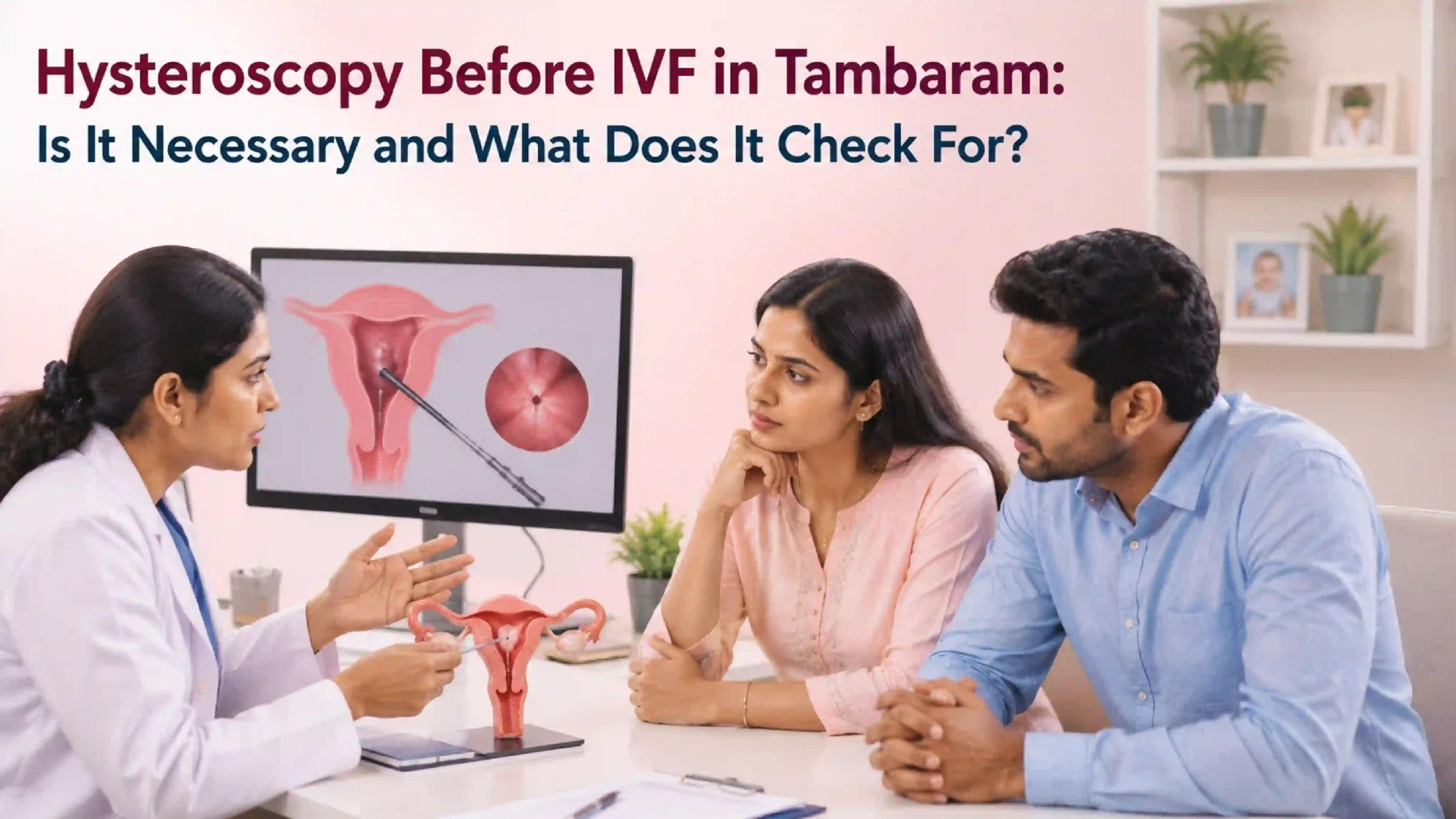
A hysteroscopy is a diagnostic procedure that allows a fertility specialist to directly examine the inside of the uterus using a thin, lighted instrument called a hysteroscope, which is gently passed through the cervix. Unlike an ultrasound, which provides an external view, hysteroscopy offers a direct, visual look at the uterine cavity itself.
This procedure can be performed as:
– Diagnostic hysteroscopy, primarily for evaluation, where the doctor examines the uterine cavity without removing tissue
– Operative hysteroscopy, where the doctor can also treat certain findings during the same procedure, such as removing small polyps or scar tissue
The choice between these depends on what’s expected to be found and whether treatment can reasonably be combined with evaluation.
Is Hysteroscopy Necessary Before Every IVF Cycle?
Not necessarily. Whether hysteroscopy is recommended before IVF depends on your individual medical history, previous fertility treatment outcomes, and findings from other diagnostic tests such as ultrasound.
Hysteroscopy before IVF may be recommended when:
– Ultrasound findings suggest possible uterine abnormalities, such as polyps, fibroids, or a septum
– There is a history of unexplained implantation failure in previous IVF cycles
– A patient has a history of recurrent pregnancy loss
– Irregular or unusual uterine bleeding patterns have been reported
– The uterine lining appears unusually thick or irregular on ultrasound
For patients without these specific indicators, some fertility specialists may proceed directly with IVF based on ultrasound findings alone. This is an individualized decision, not a universal requirement for every patient.
What Does Hysteroscopy Check For?
Hysteroscopy allows your fertility specialist to directly visualize and assess several structural factors within the uterus that can potentially affect implantation and IVF success, including:
– Uterine polyps, small growths on the uterine lining that may interfere with embryo implantation
– Submucosal fibroids, which grow into the uterine cavity and can distort its shape
– Uterine septum, a congenital condition where a band of tissue divides part of the uterine cavity
– Intrauterine adhesions or scar tissue, sometimes resulting from previous surgeries or infections
– Overall uterine cavity shape and lining condition
Identifying these factors before an embryo transfer allows your fertility specialist to address any correctable issues that might otherwise reduce the likelihood of successful implantation.
What Happens During the Procedure?
Hysteroscopy is typically performed as a relatively quick outpatient procedure. Depending on whether it’s diagnostic or operative, and your specific clinical situation, it may be done with local anesthesia, sedation, or in some cases without anesthesia. Your fertility specialist will explain the most appropriate approach for your case.
During the procedure, the hysteroscope is gently passed through the cervix into the uterus, and the doctor can view the uterine cavity via a small camera. If polyps, adhesions, or other treatable findings are identified, they may be addressed during the same procedure, depending on complexity.
What to Expect After Hysteroscopy
Most patients recover quickly after diagnostic hysteroscopy, though some mild cramping or light spotting is common in the following day or two. If any treatment was performed during the procedure, such as polyp removal, your specialist will provide specific recovery guidance and let you know when it’s appropriate to proceed with your IVF cycle.
Your fertility team will also discuss any findings with you clearly, explaining what was seen and how it may influence your treatment plan moving forward.
How Hysteroscopy Fits Into Your IVF Timeline
When recommended, hysteroscopy is typically performed before the IVF stimulation cycle begins, allowing time for any necessary treatment and healing before proceeding with egg retrieval and embryo transfer. Your fertility specialist will guide you on the appropriate timing based on your specific findings and treatment plan.
Emotional Considerations Around Additional Testing
It’s understandable to feel frustrated or anxious when additional tests are recommended, especially if you’re eager to move forward with treatment. However, identifying and addressing uterine factors beforehand is intended to support, not delay, your overall chances of a successful IVF outcome.
Open communication with your care team about why a specific test is recommended, and what it may mean for your treatment timeline, can help ease some of this uncertainty.
Promise Fertility Center's Approach
At Promise Fertility Center in Tambaram, we recommend hysteroscopy selectively, based on individual ultrasound findings, medical history, and prior treatment outcomes, rather than as a routine requirement for every patient. Our gynecologists and infertility specialists carefully review each case to determine whether this evaluation would provide meaningful, actionable information.
When hysteroscopy is recommended, our team performs both diagnostic and operative procedures, allowing us to address correctable findings such as polyps or adhesions during the same visit where clinically appropriate. We prioritize clear communication throughout, explaining findings and their relevance to your IVF plan in accessible language.
Understanding that additional procedures can feel like one more hurdle, we integrate counseling support and open dialogue into our care approach, helping patients feel informed and supported rather than overwhelmed. Conveniently located in Tambaram, our center is accessible to patients from GST Road, Chromepet, Pallavaram, and other parts of South Chennai, supporting continuity of care throughout your treatment journey.
Practical Information for Your Consultation
If your fertility specialist has recommended hysteroscopy, or if you’d like to understand whether it may be relevant for your IVF preparation, an open conversation during your consultation can help clarify next steps. For your appointment, it’s helpful to bring:
– Any previous ultrasound reports or fertility test results
– Details of prior IVF cycles, including outcomes if applicable
– A summary of your menstrual and reproductive history
– A list of current medications and relevant medical history
Our team can also help address insurance-related questions and guide you on documentation needs, including cost considerations specific to your case.
Conclusion: An Informed Step, Not an Obstacle
Hysteroscopy isn’t a requirement for every IVF patient, but when recommended, it serves an important purpose, helping identify and address uterine factors that could otherwise affect implantation. Understanding why this step is suggested for your specific case can help you approach it with clarity rather than frustration.
At Promise Fertility Center, we’re committed to explaining every recommended step honestly, so you always understand the reasoning behind your care plan. If you have questions about hysteroscopy or your upcoming IVF cycle, we invite you to schedule a confidential consultation with our fertility specialists in Tambaram. You deserve clear answers and compassionate guidance at every stage of your journey.
Frequently Asked Questions
1. Do I need a hysteroscopy before IVF in Tambaram?
This depends on your individual medical history and ultrasound findings. It’s typically recommended when there are signs of possible uterine abnormalities, prior implantation failure, or recurrent pregnancy loss, rather than for every patient.
2. What does hysteroscopy check for before fertility treatment in Chennai?
Hysteroscopy checks for uterine polyps, submucosal fibroids, a uterine septum, intrauterine adhesions, and overall uterine cavity shape and lining condition.
3. How much does hysteroscopy cost before IVF in South Chennai?
Cost varies depending on whether the procedure is diagnostic or operative, and other individual factors. Your fertility center can provide a personalized cost estimate during your consultation.
4. Is hysteroscopy a painful procedure?
Most patients experience only mild discomfort, such as cramping, and the procedure is generally well-tolerated as an outpatient process. Your specialist will discuss anesthesia options appropriate for your case.
5. How soon after hysteroscopy can I start my IVF cycle?
Timing depends on your specific findings and whether any treatment was performed during the procedure. Your fertility specialist will guide you on the appropriate timeline based on your individual recovery and treatment plan.
This article is intended for general informational purposes and does not replace personalized medical advice. Please consult a qualified fertility specialist to discuss your individual diagnosis and treatment options.