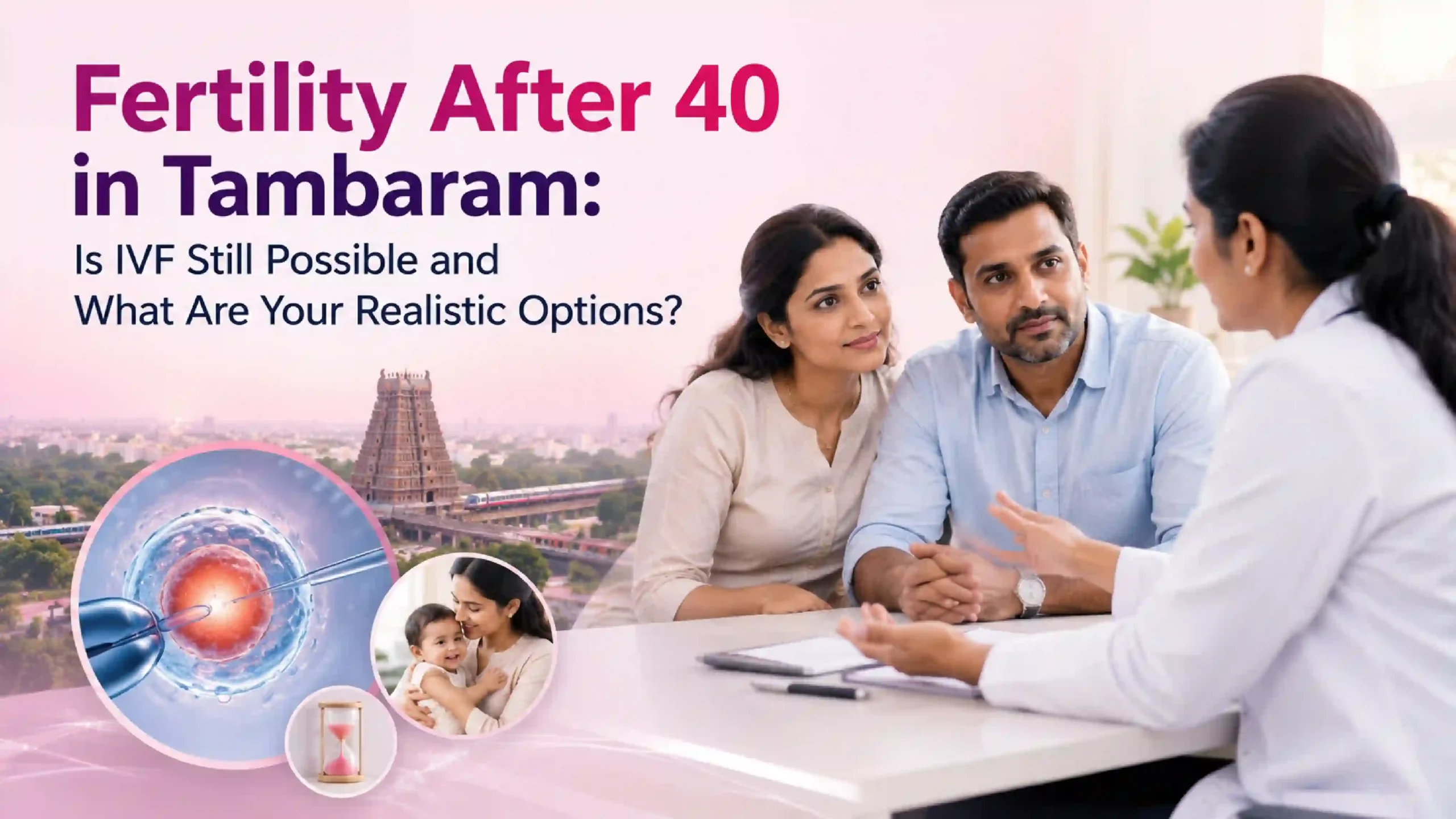
Fertility After 40 in Tambaram: Is IVF Still Possible and What Are Your Realistic Options?
- IVF
- July 7, 2026
Introduction
Choosing to pursue pregnancy after 40 brings a unique blend of hope, uncertainty, and sometimes unspoken pressure. If you’re looking into fertility after 40 in Tambaram, you may already sense that age plays a role in natural conception, but you’re likely wondering what paths are still genuinely open to you. Whatever you’re feeling right now, whether hopeful, anxious, or somewhere in between, it’s a completely normal part of this journey.
This article explores how fertility shifts with age, what treatment options such as IVF and donor egg IVF may look like for you, and how to move through this stage with clear information rather than fear. At Promise Fertility Center, our aim is to help you understand your choices honestly, so your decisions are grounded in facts, not false hope or unnecessary pressure.
As women age, fertility naturally declines because both the number and quality of eggs decrease over time, a process that begins gradually years before menopause. After 40, this shift tends to become more pronounced, which can influence how easily conception happens naturally and how a pregnancy progresses once it occurs.
This doesn’t mean pregnancy after 40 is out of reach. Plenty of women in this age group do conceive, whether naturally or with medical assistance. What it does mean is that an honest, individualized approach matters more than ever, one that takes into account your ovarian reserve, general health, and personal goals.
Several factors commonly influence fertility after 40, including:
– A reduced ovarian reserve, meaning fewer eggs remain
– Declining egg quality, which can impact fertilization and embryo growth
– A higher likelihood of conditions like fibroids or endometriosis
– Increased chances of chromosomal changes within eggs
– Hormonal shifts that can make ovulation less predictable
Getting a full fertility evaluation is often the clearest way to understand where you stand and which options make sense for you.
Can IVF Still Work After 40?
Yes, IVF continues to be a valid option for many women over 40, though the approach and expected outcomes often differ from those seen in younger patients. Since egg quantity and quality tend to decrease with age, fertility specialists may adjust standard IVF protocols, using tailored stimulation methods or more frequent monitoring throughout the cycle.
For some women, IVF using their own eggs remains a meaningful path forward, particularly when ovarian reserve testing indicates a reasonable number of eggs are still available. For others, especially those with notably diminished ovarian reserve, a specialist may introduce additional options to help broaden the realistic possibilities for pregnancy.
Considering Donor Egg IVF
Donor egg IVF stands as one of the most well-established and effective solutions for women experiencing significant age-related decline in egg quantity or quality. This process involves fertilizing eggs from a carefully screened, healthy donor and transferring the resulting embryo into the intended mother’s uterus.
It’s common for this option to feel emotionally complicated at first, and that reaction is entirely understandable. Counseling and honest conversation are strongly recommended before moving forward with donor egg treatment, since it can surface feelings tied to genetics, identity, and what family means to you, feelings that deserve time and care rather than a rushed decision.
Donor egg IVF may be worth exploring when:
– Ovarian reserve testing shows very few eggs remain
– Earlier IVF attempts using your own eggs haven’t produced viable embryos
– Egg quality issues significantly lower the chances of success with self-eggs
– After counseling, you feel this path aligns with your family-building vision
This decision should always be reached together with your care team, backed by complete information and genuine emotional support, never as a default or hurried choice.
Starting With a Thorough Diagnostic Evaluation
Before any treatment path is recommended, a comprehensive evaluation is essential. This typically involves:
– Ovarian reserve testing using hormone levels and antral follicle counts via ultrasound
– Assessing uterine health to confirm it can support a pregnancy
– General health screening, since pregnancy after 40 may involve additional considerations
– Evaluating your partner’s fertility, including semen analysis, where applicable
This evaluation gives your fertility specialist the information needed to suggest the most fitting option, whether that’s IVF with your own eggs, donor egg IVF, or in some cases, a conversation about other family-building routes such as adoption or surrogacy.
Setting Realistic Expectations
It’s natural to want reassurance, but responsible fertility care means steering clear of guarantees. Outcomes after 40 depend on a combination of individual factors, including ovarian reserve, uterine receptivity, overall health, and the treatment pathway selected.
Steps that can genuinely support your chances include:
– Beginning the evaluation process sooner rather than later
– Selecting a treatment plan tailored specifically to your diagnosis
– Supporting overall health through balanced nutrition and consistent medical care
– Managing existing conditions like thyroid imbalances or high blood pressure
– Seeking emotional support or counseling throughout treatment
A trustworthy fertility specialist will always pair hope with honesty, helping you see both what’s possible and what a realistic path may look like specifically for you.
Navigating the Emotional Side of This Journey
Many women exploring fertility after 40 describe a push and pull between hope and pressure, hope that treatment might help, and pressure from time constraints, social expectations, or their own internal timeline. These feelings are legitimate and deserve acknowledgment, not dismissal.
Feeling isolated is also common, especially if peers conceived easily at a younger age. Leaning on a supportive care team, and where helpful, a counselor or support community, can make this journey feel far more manageable.
Promise Fertility Center's Approach
At Promise Fertility Center in Tambaram, we recognize that fertility after 40 calls for a thoughtful, personalized approach rather than a one-size-fits-all protocol. Our gynecologists and infertility specialists start with detailed diagnostic testing to understand your ovarian reserve, uterine health, and overall fertility landscape before suggesting any treatment direction.
We provide a full spectrum of options, including IVF with self-eggs where clinically suitable, and donor egg IVF for patients where this path is medically recommended and personally chosen. Our embryology lab supports precise, closely monitored treatment cycles, and our team stays committed to clear, transparent communication at every stage, explaining what each option can realistically offer without overstating results.
Understanding that this journey carries emotional weight, we build counseling support directly into our care process, helping patients and couples work through decisions around donor eggs, treatment planning, or alternative paths with empathy and respect. Conveniently based in Tambaram, our center remains accessible to patients from GST Road, Chromepet, Pallavaram, and other parts of South Chennai, so continuity of care doesn’t come with added travel strain during an already demanding time.
Preparing for Your First Visit
If you’re considering fertility treatment after 40, scheduling an early consultation can help you understand your choices before time-sensitive decisions become more limited. For your first appointment, it’s generally helpful to bring:
– Any prior fertility or hormonal test results
– A summary of your menstrual and reproductive history
– Details of any previous pregnancies or fertility treatments
– A list of current medications and existing health conditions
Our team can also help answer insurance-related questions and guide you on what documentation may be useful moving forward.
Frequently Asked Questions (FAQs)
1. Can I still get pregnant with IVF after 40?
Pregnancy with IVF after 40 is possible for many women, though outcomes depend on individual factors such as ovarian reserve and egg quality. A fertility evaluation can help clarify your specific situation.
2. What are my fertility options at 40?
Options may include IVF using your own eggs, donor egg IVF, or in some cases, exploring alternative family-building paths such as adoption or surrogacy, depending on your diagnostic results and personal preferences.
3. Is donor egg IVF available near Tambaram for women over 40?
Yes, donor egg IVF is offered at Promise Fertility Center in Tambaram for patients for whom this path is clinically appropriate and personally chosen after counseling.
4. Does age after 40 always mean I need donor eggs?
Not necessarily. Some women over 40 still have a reasonable ovarian reserve and may pursue IVF using their own eggs. This is determined through diagnostic testing rather than age alone.
5. How soon should I consult a fertility specialist if I am over 40 and trying to conceive?
Because fertility can decline more noticeably with age, it is generally advisable to seek a consultation sooner rather than later, allowing more time to explore appropriate options.
Conclusion: Your Options Are Still Open
Fertility after 40 isn’t the end of the road, it’s simply a stage that calls for informed, personalized care. Whether your path leads to IVF with your own eggs, donor egg IVF, or continued exploration of what fits your life best, understanding your options early gives you the clearest possible view of what lies ahead.
At Promise Fertility Center, we’re here to walk alongside you with honest medical guidance, advanced fertility care, and genuine emotional support, without empty promises. If you’re ready to explore your options with clarity, we invite you to schedule a confidential consultation with our fertility specialists in Tambaram. You deserve compassionate, realistic guidance as you take this next step forward.
This article is intended for general informational purposes and does not replace personalized medical advice. Please consult a qualified fertility specialist to discuss your individual diagnosis and treatment options.