
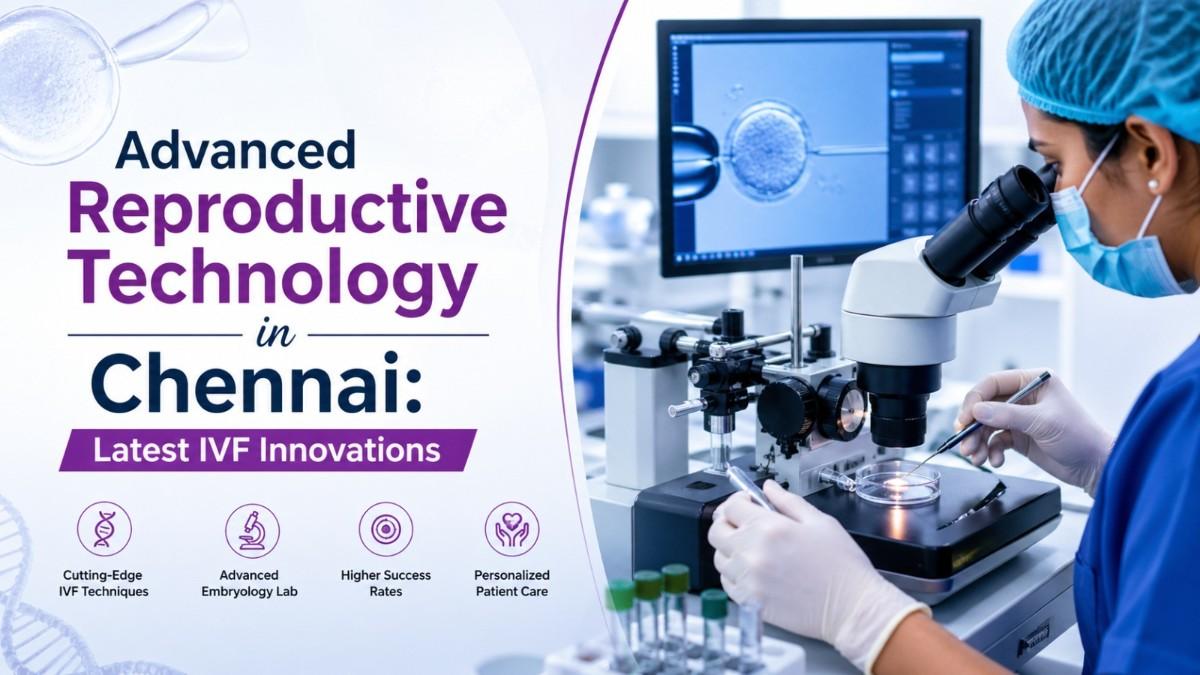
Advanced Reproductive Technology in Chennai: Latest IVF Innovations
- IVF
- May 2, 2026
Introduction
When the journey to parenthood becomes medically complex, the availability of advanced reproductive technology in Chennai can make a profound difference. For couples who have faced repeated disappointment, or who carry specific genetic or medical concerns, knowing that world-class fertility science is accessible close to home brings genuine hope.
Assisted reproductive technology (ART) has evolved rapidly over the past two decades. What was once limited to basic IVF has expanded into a sophisticated field encompassing genetic screening, precision embryo selection, fertility preservation, and laboratory innovations that improve outcomes at every stage of treatment.
At Promise Fertility Center in Tambaram, Chennai, we are committed to offering evidence-based, technologically advanced fertility care within a compassionate, patient-centred environment. This article explains the most important advances in reproductive technology available in Chennai today, what they mean for your treatment, and how Promise Fertility Center applies these tools to support your individual journey.
Assisted reproductive technology refers to a range of medical procedures used to help individuals and couples achieve pregnancy when natural conception has not been possible. The term covers a spectrum of treatments — from ovulation induction and intrauterine insemination (IUI) to in vitro fertilisation (IVF), intracytoplasmic sperm injection (ICSI), and more specialised procedures involving genetic testing and fertility preservation.
The field is guided internationally by bodies such as the European Society of Human Reproduction and Embryology (ESHRE) and the American Society for Reproductive Medicine (ASRM), and in India by the Indian Council of Medical Research (ICMR). These standards ensure that ART is practised safely, ethically, and with consistent quality.
The Latest IVF Technology Available in Chennai
Intracytoplasmic Sperm Injection (ICSI)
ICSI is now one of the most widely used techniques in IVF worldwide, and it represents a major advance in treating male factor infertility. In conventional IVF, sperm and eggs are placed together and fertilisation occurs naturally in the laboratory. In ICSI, a single healthy sperm is selected and injected directly into the egg using a microscopic needle.
This approach is particularly beneficial for men with low sperm count, poor sperm motility, abnormal sperm morphology, or cases where sperm must be surgically retrieved (using procedures such as TESA or PESA). ICSI has significantly improved fertilisation rates for couples where male infertility was previously a major barrier to success.
Preimplantation Genetic Testing (PGT)
Preimplantation genetic testing allows embryos to be screened for chromosomal abnormalities or specific genetic conditions before they are transferred to the uterus. There are two primary forms:
- PGT-A (Preimplantation Genetic Testing for Aneuploidies): Screens embryos for the correct number of chromosomes. Chromosomally normal (euploid) embryos are more likely to implant successfully and less likely to result in miscarriage. PGT-A is particularly relevant for women over 35, those with recurrent implantation failure, or couples with a history of pregnancy loss.
- PGT-M (Preimplantation Genetic Testing for Monogenic Disorders): Used when one or both partners carry a known genetic condition — such as thalassaemia, sickle cell disease, or cystic fibrosis — to screen embryos before transfer and reduce the risk of passing the condition to a child.
Time-Lapse Embryo Monitoring
Traditional embryo culture involves removing embryos from the incubator periodically to assess their development under a microscope. Time-lapse imaging systems allow continuous, uninterrupted observation of embryo development through a built-in camera, without disturbing the stable incubator environment.
This technology generates detailed developmental data that helps embryologists select the embryo with the highest implantation potential — improving the precision of embryo selection without compromising embryo quality through unnecessary disturbance.
Vitrification — Advanced Embryo and Egg Freezing
Vitrification is a rapid freezing technique that has transformed the field of fertility preservation. Unlike older, slower freezing methods that could damage cells through ice crystal formation, vitrification cools biological material so rapidly that ice crystals do not form. Survival rates for vitrified eggs and embryos are now consistently high, making egg freezing a clinically reliable option.
Vitrification is used in:
- Fertility preservation for women facing cancer treatment or other medical interventions that may affect ovarian function
- Elective egg freezing for women who wish to preserve their fertility for personal reasons
- Embryo banking — the storage of excess embryos from an IVF cycle for future frozen embryo transfers
- Donor egg programmes
Endometrial Receptivity Testing
Even when a high-quality embryo is available, implantation failure can occur if the uterine lining (endometrium) is not in its optimal receptive state at the time of transfer. Endometrial receptivity testing analyses the endometrial lining at a molecular level to identify the individual’s personal implantation window — the narrow period when the endometrium is most receptive to an embryo.
This test is particularly valuable for women who have experienced repeated implantation failure despite good embryo quality.
Laser-Assisted Hatching
Before an embryo can implant in the uterine lining, it must break free from its outer shell (the zona pellucida) — a process called hatching. In some embryos, particularly those with a thicker or harder shell, this process may be impaired. Laser-assisted hatching uses a precise, controlled laser to create a small opening in the zona pellucida, potentially facilitating implantation.
This technique is used selectively, based on individual embryo characteristics and clinical history, rather than as a routine procedure.
Modern Fertility Treatment in Chennai: Lifestyle and Preparation
Advanced technology produces the best outcomes when paired with a healthy foundation. Couples preparing for ART treatment are advised to:
- Achieve or maintain a healthy body weight — excess weight can affect hormonal balance and response to stimulation
- Avoid smoking and alcohol, both of which negatively affect egg and sperm quality
- Take a daily folic acid supplement (and ideally a prenatal vitamin) from at least three months before treatment
- Manage chronic conditions such as thyroid disease, diabetes, or hypertension with appropriate medical care
- Seek emotional support — the psychological demands of ART are significant, and counselling can improve both wellbeing and treatment experience
Promise Fertility Center's Approach to Advanced Reproductive Care
At Promise Fertility Center in Tambaram, we understand that the decision to pursue advanced fertility treatment is not made lightly. Couples come to us after months or years of trying, often carrying the weight of previous disappointments. Our role is to meet that experience with expertise, honesty, and genuine compassion.
Our clinic is led by Dr. Annith Kumar, a reproductive medicine specialist with international training, and Dr. Umaiyal, who brings deep expertise in women’s reproductive health. Together, they bring a treatment philosophy that combines clinical excellence with individualised care — because no two fertility journeys are the same.
We offer a full range of ART procedures, including IVF, ICSI, IUI, PGT, vitrification-based fertility preservation, and surgical sperm retrieval. Every treatment plan is developed after a thorough diagnostic evaluation, ensuring that the technology used is matched to the specific needs of each couple.
Our embryology laboratory is equipped with modern incubation and culture systems designed to maintain optimal conditions for embryo development. We are committed to transparent communication at every stage — including honest, context-appropriate discussions about realistic success rates based on your individual diagnosis, age, and treatment history.
Promise Fertility Center is easily accessible from Chromepet, Pallavaram, Perungalathur, GST Road, and across South Chennai, making specialist ART care convenient for families throughout the region.
When to Seek a Consultation for Advanced Fertility Treatment
Consider booking a consultation if:
- You have been trying to conceive for 12 months without success (or 6 months if you are over 35)
- You have previously undergone IVF without success
- You or your partner carry a known genetic condition
- You have been advised of a low ovarian reserve, poor embryo quality, or repeated implantation failure
- You are interested in fertility preservation before medical treatment or for personal reasons
For your first appointment, bring any previous fertility investigation reports, IVF cycle summaries, semen analysis results, and a record of your medical history. All consultations are conducted in complete confidence.
Conclusion: Your Next Step Towards Advanced Fertility Care in Chennai
The rapid progress of reproductive medicine means that more couples than ever before have a genuine path to parenthood — even in complex clinical situations. Advanced reproductive technology in Chennai is no longer confined to large metropolitan hospitals; it is available, accessible, and personalised at Promise Fertility Center in Tambaram.
If you are ready to explore what modern fertility science can offer you, we invite you to take the first step. Book a confidential consultation with our team and allow us to understand your story, evaluate your individual situation, and guide you toward the most appropriate path forward.
You deserve care that is both scientifically rigorous and deeply human. At Promise Fertility Center, that is exactly what we offer.
Frequently Asked Questions (FAQs)
Q: What is the difference between IVF and ICSI?
In standard IVF, eggs and sperm are placed together in a laboratory dish and fertilisation occurs naturally. In ICSI, a single sperm is injected directly into each egg. ICSI is recommended when there is a male factor concern, such as low sperm count or poor motility, or when previous IVF cycles have had poor fertilisation results.
Q: Is preimplantation genetic testing recommended for everyone?
No. PGT is most beneficial for specific patient groups — women over 35, couples with a history of recurrent miscarriage or implantation failure, and those who carry a known genetic condition. Your fertility specialist will advise whether PGT is clinically appropriate for your situation.
Q: Is egg freezing effective? How long can eggs be stored?
With modern vitrification techniques, egg survival rates after thawing are consistently high. Eggs can be stored for extended periods — in India, ICMR guidelines currently allow storage for up to five years, with the possibility of extension under specific circumstances. The effectiveness of egg freezing is influenced by the woman’s age at the time of freezing; younger women generally achieve better outcomes.
Q: How many IVF cycles might I need?
This varies significantly based on age, diagnosis, embryo quality, and individual response to treatment. Some couples conceive in their first cycle; others require multiple attempts. Your fertility specialist will give you a realistic assessment based on your specific clinical profile — no ethical clinic can guarantee a pregnancy outcome.
Q: Does advanced technology guarantee IVF success?
No. Advanced reproductive technology significantly improves the precision, safety, and potential outcomes of fertility treatment — but it does not guarantee pregnancy. Success depends on a combination of factors including age, egg and sperm quality, embryo development, and uterine receptivity. Promise Fertility Center is committed to presenting realistic expectations at every stage.
Q: Are advanced fertility treatments affordable in Chennai?
The cost of ART procedures varies depending on the specific treatment required, the number of cycles undertaken, and whether additional tests or techniques such as PGT or time-lapse monitoring are used. At Promise Fertility Center, we provide transparent pricing and discuss all cost considerations openly before treatment begins, so there are no unexpected surprises.
Q: What should I do if I have failed IVF cycles elsewhere?
A failed IVF cycle is a significant and difficult experience. It does not mean that future success is impossible — it means that a thorough review of all previous treatment details is needed to identify what adjustments may improve outcomes. Our team welcomes couples who have had previous unsuccessful cycles and will conduct a comprehensive assessment before recommending next steps.
Medical Disclaimer: This article is intended for general informational purposes only and does not constitute medical advice. Fertility outcomes vary based on individual clinical factors including age, diagnosis, and overall health. No fertility treatment guarantees pregnancy. Readers are encouraged to consult a qualified fertility specialist for personalised medical guidance. Promise Fertility Center adheres to ICMR guidelines for assisted reproductive technologies.