Fertility Treatment for Irregular Periods in Chennai: PCOS & Solutions
- IVF
- April 29, 2026
Introduction
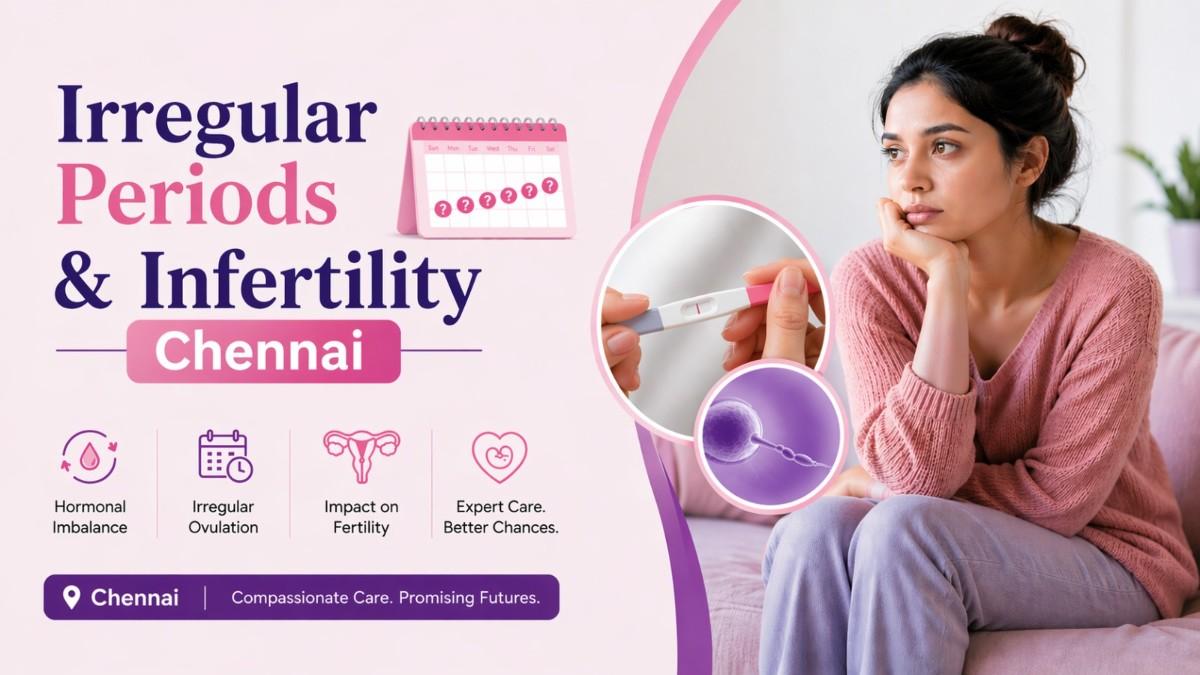
For many women in Chennai, irregular periods are more than just an inconvenience — they can be a quiet signal that something deeper is affecting reproductive health. If you have been struggling with unpredictable cycles and finding it difficult to conceive, you are not alone. Irregular periods infertility in Chennai is one of the most common concerns women bring to fertility clinics, and the good news is that in most cases, it is a treatable condition.
Irregular menstrual cycles often indicate that ovulation — the release of a mature egg each month — is not happening consistently or at all. Without ovulation, conception becomes significantly more difficult. But this does not mean parenthood is out of reach.
This article explores the relationship between irregular periods and fertility, the most common underlying causes, available treatment options, and how Promise Fertility Center in Tambaram, Chennai can support you on your journey to becoming a parent.
A typical menstrual cycle ranges from 21 to 35 days. Periods that consistently fall outside this range, vary significantly from month to month, or are frequently absent are considered irregular.
Occasional irregularity due to stress or illness is common and usually not a concern. However, when cycles are persistently irregular — especially when you are trying to conceive — it is worth investigating the underlying cause.
Irregular periods are not a diagnosis in themselves. They are a symptom, and identifying the root cause is the first step toward effective treatment.
Common Causes of Irregular Periods That Affect Fertility
Polycystic Ovary Syndrome (PCOS)
PCOS is the most prevalent cause of irregular periods and ovulation-related infertility in women of reproductive age. It is a hormonal condition in which the ovaries produce excess androgens (male hormones), disrupting the normal development and release of eggs.
Women with PCOS may experience cycles that are very long (more than 35 days), very short, or absent for months at a time. Despite the name, not all women with PCOS have cysts on their ovaries, and the condition presents differently in different individuals.
In Chennai, PCOS is increasingly common, with dietary patterns, sedentary lifestyles, and genetic factors all playing a role. The condition is highly manageable with the right medical support.
Thyroid Disorders
Both an underactive thyroid (hypothyroidism) and an overactive thyroid (hyperthyroidism) can disrupt menstrual regularity and ovulation. Thyroid hormones play a central role in regulating the reproductive system, and even mild imbalances can affect cycle length and fertility.
A simple blood test can identify thyroid dysfunction, and treatment — typically with medication — often restores normal cycles relatively quickly.
Hyperprolactinaemia
Elevated levels of prolactin (the hormone responsible for milk production) can suppress ovulation and cause irregular or absent periods. This condition, known as hyperprolactinaemia, can result from a small benign growth on the pituitary gland (prolactinoma) or from certain medications.
It is treatable in most cases with medication that normalises prolactin levels.
Low Ovarian Reserve
As women age, the quantity and quality of their eggs naturally decline. This can result in shorter, irregular cycles. Women under 35 can also experience diminished ovarian reserve, and the condition is identifiable through an AMH (anti-Müllerian hormone) blood test and antral follicle count (AFC) ultrasound.
Stress, Weight, and Lifestyle Factors
Significant physical or emotional stress, being significantly underweight or overweight, and extreme exercise can all suppress the hormonal signals needed for regular ovulation. These are often correctable with lifestyle changes alongside medical support.
Can Irregular Periods Cause Infertility?
Yes — but the connection is specific. Irregular periods signal inconsistent or absent ovulation. Since conception requires the meeting of a mature egg and sperm, unpredictable ovulation makes timing intercourse difficult and reduces monthly chances of conception.
However, irregular periods do not mean infertility is permanent or untreatable. Many women with irregular cycles conceive successfully with appropriate medical support.
Treatment Options for Irregular Periods and Fertility in Chennai
Lifestyle Modifications
For women whose irregular cycles are linked to weight, diet, or stress, targeted lifestyle changes can significantly improve menstrual regularity and ovulation. Even a modest weight reduction of 5–10% in women with PCOS has been shown in research to restore ovulation in a meaningful proportion of patients.
A fertility specialist will assess your individual situation and may refer you to a nutritionist or counsellor as part of a holistic treatment plan.
Ovulation Induction
Ovulation induction uses low-dose oral medications — most commonly letrozole or clomiphene citrate — to stimulate the ovaries to produce and release a mature egg. It is typically the first-line fertility treatment for women with PCOS or other ovulatory disorders.
The process involves careful monitoring through blood tests and ultrasound scans to track follicle development and time intercourse or intrauterine insemination (IUI) appropriately.
Intrauterine Insemination (IUI)
IUI is a minimally invasive procedure in which washed, concentrated sperm is placed directly into the uterus at the time of ovulation. When combined with ovulation induction, IUI can significantly improve the chances of conception for women with ovulation-related infertility.
It is a well-tolerated procedure with minimal discomfort and is often a helpful step before considering IVF.
For women who do not respond adequately to ovulation induction, or where other fertility factors are present (such as tubal issues or male factor infertility), IVF may be recommended. IVF bypasses the need for natural ovulation by stimulating the ovaries to produce multiple eggs, retrieving them, fertilising them in the laboratory, and transferring the resulting embryo to the uterus.
At Promise Fertility Center, IVF protocols are carefully individualised — including gentle stimulation approaches for women with PCOS who are at risk of ovarian hyperstimulation syndrome (OHSS).
Hormonal and Medical Management
For conditions such as thyroid disorders or hyperprolactinaemia, appropriate medical treatment (thyroid hormone replacement or dopamine agonists, respectively) can restore regular cycles and ovulation without the need for assisted reproduction in many cases.
Promise Fertility Center's Approach to Irregular Periods and Infertility
At Promise Fertility Center, located in Tambaram and easily accessible from Chromepet, Pallavaram, Perungalathur, and along the GST Road corridor, we take a thorough, patient-first approach to menstrual irregularity and fertility challenges.
Our medical team, led by Dr. Annith Kumar — a reproductive medicine specialist with international qualifications — and Dr. Umaiyal, begins every patient’s journey with a comprehensive diagnostic workup. This includes hormonal profiling (AMH, FSH, LH, prolactin, thyroid function), pelvic ultrasound for antral follicle count and uterine assessment, and a review of your full medical and menstrual history.
We understand that women with PCOS and irregular cycles often carry both medical uncertainty and emotional fatigue. Many of our patients have spent months or years trying to conceive before reaching us. Our approach is to listen first, investigate thoroughly, and then design a stepwise treatment plan that is realistic, evidence-based, and aligned with your personal goals.
From ovulation induction and IUI to advanced IVF protocols, our team provides continuity of care at every stage. Our nursing staff offers consistent support between appointments, ensuring you always have someone to speak to when questions or concerns arise.
We are committed to transparent communication — you will always understand your diagnosis, your treatment plan, and what to realistically expect at each step.
When to Seek a Consultation
Consider booking a fertility consultation at Promise Fertility Center if:
- You have been trying to conceive for 12 months or more without success (or 6 months if you are over 35)
- Your periods are consistently irregular, very heavy, very light, or absent
- You have been previously diagnosed with PCOS, thyroid issues, or another hormonal condition
- You experience symptoms associated with PCOS such as excess hair growth, acne, or unexplained weight gain
- You have concerns about your menstrual cycle and how it may be affecting your fertility
For your first visit, bring any previous blood test results, ultrasound reports, and a record of your menstrual cycle over recent months. Your appointment is completely confidential.
Your Next Step Starts Here
Irregular periods can feel like an obstacle — but for most women, they are a signpost, not a dead end. With the right diagnosis and treatment, many women with ovulation-related infertility go on to conceive successfully.
At Promise Fertility Center in Tambaram, Chennai, we are here to help you understand your body, explore your options, and walk with you toward the family you are hoping to build. Our team brings clinical expertise, compassionate care, and genuine commitment to every patient’s journey.
Take the first step. Book your consultation today — because your story is not over yet.
Frequently Asked Questions (FAQs)
Q1. Can I get pregnant if I have irregular periods?
Yes. Irregular periods indicate inconsistent ovulation, but many women with irregular cycles conceive successfully with appropriate fertility treatment. A specialist can identify the underlying cause and recommend the right treatment for your situation.
Q2. How do I know if my irregular periods are caused by PCOS?
PCOS is diagnosed based on a combination of factors: irregular cycles, elevated androgen levels (which may cause symptoms like excess facial hair or acne), and the appearance of the ovaries on ultrasound. A blood test and pelvic scan at a fertility clinic can confirm or rule out PCOS.
Q3. What is the first step if I have irregular periods and want to get pregnant?
Book a consultation with a fertility specialist. An initial evaluation including blood tests (hormonal profile, thyroid, AMH) and a pelvic ultrasound will identify the cause and guide your treatment plan.
Q4. How long does ovulation induction treatment take?
Each ovulation induction cycle is typically one menstrual cycle in length (approximately 4–6 weeks including monitoring). Some women achieve pregnancy in the first few cycles; others may require several attempts or may progress to IUI or IVF.
Q5. Is PCOS curable?
PCOS is a chronic condition that cannot be permanently cured, but it is very effectively managed. With the right combination of lifestyle changes and medical treatment, most women with PCOS can achieve regular ovulation and have successful pregnancies.
Q6. Will I need IVF if I have irregular periods?
Not necessarily. Many women with ovulation-related irregular periods respond well to first-line treatments such as ovulation induction and IUI. IVF is typically considered when simpler treatments have not been successful or when other fertility factors are present.
Q7. Are there any risks to ovulation induction treatment?
Ovulation induction is generally safe and well-tolerated. The main risks include a small possibility of multiple pregnancy (twins or more) and, in rare cases, mild ovarian hyperstimulation. Your specialist will monitor your response carefully to minimise these risks.
Q8. Is infertility treatment for irregular periods expensive in Chennai?
The cost depends on the treatment required. Ovulation induction and IUI are considerably more affordable than IVF. At Promise Fertility Center, we offer transparent pricing with no hidden costs. We will always discuss the most cost-effective treatment pathway for your specific diagnosis before proceeding.
Medical Disclaimer: This article is for general informational purposes only and does not constitute medical advice. Fertility outcomes vary based on individual clinical factors. No treatment guarantees pregnancy. Please consult a qualified fertility specialist for personalised guidance. Promise Fertility Center follows ICMR guidelines for assisted reproductive technologies.